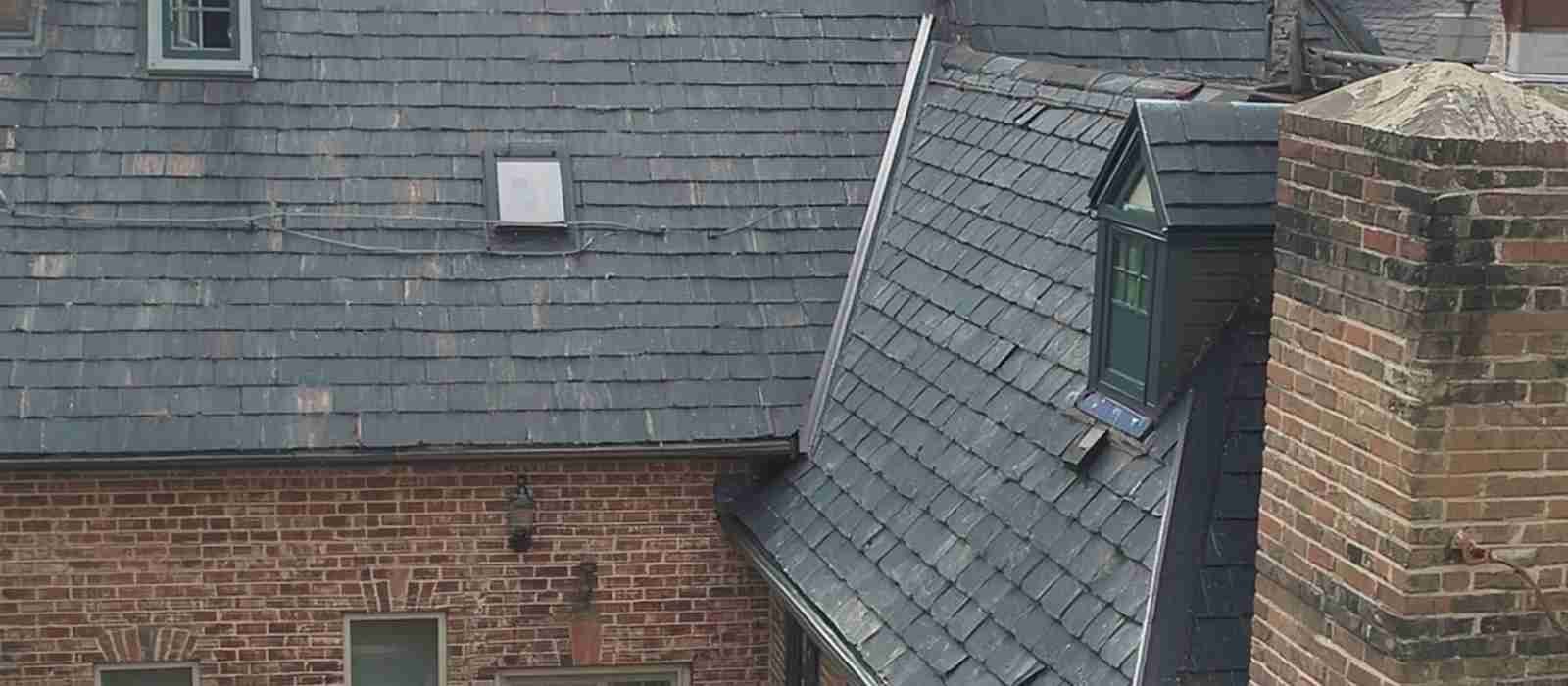
The Tudors, Georgians and brick colonials lining River Road, Falls Road and Bradley Boulevard were built in an era when slate was the default roofing material. A century later, those slate roofs are still there. Most have never been touched. A few have been ruined by well-meaning asphalt roofers attempting repairs they had no business attempting. And a handful have been properly restored, with another 80 years of service life ahead of them.
If you own a slate roof in Potomac, Bethesda, Chevy Chase or anywhere in the historic Maryland and DC corridor, the worst thing you can do when a leak appears is call a standard roofing company. The skills required to work on slate are closer to those of a stonemason or coppersmith than a modern roofer. This guide is the honest version of what you need to know before you make that decision.
Why Slate Outlasts Everything Else
Slate is metamorphic stone. It does not absorb water, does not feed mold, does not warp, does not soften in heat, and does not become brittle in cold. The original slate roofs installed in 1920s Potomac were quarried from Vermont and Virginia mountains formed 400 million years ago. According to the Slate Roofing Contractors Association of North America, properly installed slate roofs routinely serve 100 to 200 years.
Asphalt shingles, by comparison, are a petroleum product engineered to deliver a 25 to 30 year service life under ideal conditions. They oxidize, lose granules and eventually become brittle. A slate roof at year 100 typically looks better than an asphalt roof at year 15. There is no comparison on durability, and increasingly no comparison on lifecycle cost when you stretch the math across the full lifespan of the home.
The catch is that slate roofs require ongoing knowledgeable care. They do not require a lot of care, but they require the right care. Most slate roofs that fail prematurely fail because a homeowner hired the cheapest roofer to "fix a couple slates" and that roofer broke 20 other slates while walking on the roof.
Restoration vs Full Replacement: How to Tell
This is the most expensive decision a slate roof owner makes, and the wrong answer can mean the difference between $40,000 and $200,000. The honest framework looks at three components separately: the slates themselves, the flashings, and the structural deck and underlayment.
Slate Assessment
Individual slate tiles either ring true when tapped or they sound dead. A dead slate is delaminating - the layers are separating internally - and will fail within years. We do a representative tap-test sample on each elevation, then estimate the percentage of dead versus sound slates. We also pull a few slates and inspect the underside, where weathering is most apparent. If 80% or more of the original slate is sound, restoration is the right call. If you are below 60%, full replacement starts to make sense. The middle range requires judgment, and we will tell you honestly which side of the line you are on.
Flashing Assessment
This is where most slate roofs actually fail. The flashings around chimneys, valleys, dormers and skylights are the first thing to degrade. Original copper flashings from the 1920s and 1930s are often still serviceable but the soldered joints have failed. Original galvanized steel flashings are usually past their life. Failing flashings cause 90% of slate roof leaks. Most "slate roof problems" homeowners describe are actually flashing problems.
Deck and Underlayment
Slate is heavy (roughly 700 to 1000 pounds per square depending on thickness) and the wood deck underneath has to support it for a century. We inspect the deck from inside the attic for any sign of sagging, cracking, water damage, or insect activity. Old felt underlayments often have nothing structural left but the slate has been holding everything in place. During restoration, we typically install a high-temp synthetic underlayment in the worked areas only.
Vermont vs Buckingham Virginia vs Spanish Slate
If you are restoring an original slate roof in Potomac, you want replacement slates that match the original quarry as closely as possible. Color and texture vary significantly by source, and a poor match is immediately visible.
| Slate Source | Expected Lifespan | Best Use |
|---|---|---|
| Vermont (Poultney, Granville) | 100 to 150 years | Premium American slate. Available in greens, purples, grays, reds. Matches most 1920s-1940s Potomac roofs. |
| Buckingham Virginia | 150+ years | The longest-lasting American slate. Black-gray, near-zero fade. The premium standard for restoration projects. |
| Pennsylvania (Peach Bottom) | 100 to 150 years | Historic favorite, harder to source today. Excellent for matching older Mid-Atlantic homes. |
| Spanish (S1 grade) | 80 to 125 years | Quality varies by quarry. S1-rated from established Galicia quarries is reliable. Most common imported option in 2026. |
| Welsh / Other Imported | 80 to 150 years | Available but increasingly expensive. Use case-by-case. |
For restoration projects where the original quarry is no longer operating, we work to source the closest visual and dimensional match. Reclaimed slate from demolished period buildings is also an option when authenticity matters most. Our specialty roofing service page lists the slate sources we work with regularly.
The Five Things That Actually Fail on a Slate Roof
Understanding what fails first changes how you should approach restoration. In our field experience across slate restorations in Potomac, Bethesda and the surrounding area, failures happen in this order:
- Soldered joints on copper flashing. The lead-tin solder used in original flashings eventually develops hairline cracks. Re-soldering is straightforward for a coppersmith, impossible for a standard roofer.
- Step flashing at chimneys. The most leak-prone location on any slate roof. The masonry shifts slightly over decades, the flashing follows, and gaps open at the counter-flashing.
- Valley flashings. Either open valleys with exposed metal or closed valleys with woven slate. Open valleys are easier to inspect and restore. Closed valleys require more skilled craftsmanship.
- Individual cracked or missing slates. Wind damage, falling tree limbs, or earlier botched repairs. These can be replaced one at a time with copper slate hooks.
- Ridge cap and hip slates. The mortared ridge of an original slate roof often loses bond after 60+ years. Re-pointing or full ridge rebuild is common in restoration.
The most common call we get from Potomac homeowners is after a non-specialist roofer has already been on the roof. To replace one slate, you have to access the nails of the slate above it. Doing this correctly requires a slate ripper and patience. Done incorrectly, you break two or three adjacent slates. We have seen single-slate jobs turn into 40-slate emergency replacements because the original repairman did not own the right tools.
Real 2026 Slate Roof Restoration Costs
Slate work is priced by square (100 sq ft of roof area) and by component. A typical Potomac home with a slate roof has 30 to 60 squares of roof area. The cost ranges below reflect actual project pricing in the Potomac and broader Montgomery County market.
| Project Scope | Cost Range | What's Included |
|---|---|---|
| Focused Repair | $8,000 to $20,000 | Replace 5 to 30 broken or missing slates, repair one or two flashing locations, re-point a section of ridge. For known localized issues, not a full restoration. |
| Targeted Restoration | $25,000 to $50,000 | Replace all broken slates across the roof (typically 10% to 15% of total), complete chimney flashing rebuild in copper, valley flashing replacement, ridge re-pointing, slate-rate inspection. |
| Comprehensive Restoration | $50,000 to $90,000 | Everything above plus full perimeter flashing rebuild, dormer flashing, partial deck repair where deteriorated, underlayment in worked areas, copper gutter work. |
| Full Slate Replacement | $80,000 to $250,000+ | Complete tear-off of old slate (carefully salvaged where possible), new deck and underlayment, new Vermont or Buckingham slate, all-new copper flashings, ridge work. For roofs where restoration is no longer viable. |
The Potomac market specifically runs on the higher end of these ranges due to the typical home size, roof complexity (multiple dormers, varied slopes), and slate area. Estate homes regularly exceed $150,000 even for restoration scope. We provide detailed line-item proposals so you can see exactly what each scope element costs and prioritize what matters most.
Get a Detailed Slate Roof Assessment
The right answer for your specific slate roof requires on-roof inspection by a slate specialist. We do this assessment at no cost, with a detailed written report identifying what is sound, what needs restoration, and what (if anything) needs replacement.
How to Vet a Slate Roofing Contractor in Maryland
The single biggest risk in any slate project is hiring someone who is in over their head. Slate is unforgiving of poor workmanship and the damage from a bad install or repair is often invisible until you have a major leak years later. These are the questions we recommend asking any contractor before you let them on your slate roof.
- How many slate-specific projects have you completed in the last 24 months? "Some" is not an answer. You want specific recent project counts.
- Can I see three recent local slate projects? Photos are easy to fake. Drive-by addresses where the homeowner agreed to be referenced are not.
- Do you have your own copper sheet metal shop or coppersmith? If they sub out the copper work, you need to know who is actually doing it.
- What slate sources do you carry? A serious slate contractor names quarries, not brands.
- What tools do you use for individual slate replacement? The answer should include "slate ripper" and "copper slate hooks" without prompting.
- Are you a member of the Slate Roofing Contractors Association or similar trade body? Not required but a positive signal.
- What is your written warranty on labor? Manufacturer warranty on slate is mostly irrelevant since the slate itself rarely fails. Labor warranty is everything.
If a contractor pivots to discussing asphalt alternatives or recommends "modern materials" for a historic slate roof, they are telling you they do not work on slate. Walk away. The right answer is a slate-only restoration approach that maintains the character and value of your home.
Our Slate Restoration Process
Every slate project we take on in Potomac follows the same disciplined sequence. No subcontractors. No rushed work. No shortcuts on flashing or sourcing.
Step 1: On-Roof Assessment. Two-person inspection covering every elevation. Sample tap-testing on each face, attic inspection, flashing condition documentation, photographic record. Free, takes 2 to 3 hours.
Step 2: Written Assessment Report. Detailed findings document with photographs, recommended scope, slate source recommendation, and itemized estimate. Delivered within 5 business days.
Step 3: Slate Sourcing and Permitting. We confirm slate availability with the chosen quarry, file Montgomery County permits (slate work is permit-required), and order materials. Lead time for Vermont or Buckingham slate is typically 4 to 8 weeks.
Step 4: Restoration Work. Our own in-house crew including a dedicated coppersmith handles every aspect from staging through final cleanup. We work on the roof using slate-specific techniques - cushioned ladder hooks, walk boards on softer slates, slate rippers for individual replacements.
Step 5: Final Inspection and Warranty. Walk-around inspection, photographic record of finished work, written warranty documentation. We stay engaged for the long term - many of our slate clients have us back every 5 to 10 years for inspection and maintenance.


