The pressure-treated deck on the back of a typical Clarksburg or Germantown home is a 1990s product still being sold in 2026. It rotates between two states. Either you spent the weekend power-washing and re-staining it, or you have not, and it shows. Boards cup. Nails pop. The railing gets a splinter in it. By year 12 to 15, you are budgeting for full replacement.
Composite changed all of that. The first generation of composite decking from the late 1990s had real problems. The current generation, after 25 years of material science improvements, does not. A modern composite deck installed correctly in Clarksburg or Germantown will outlast the original house roof and require essentially zero maintenance over its lifespan. This guide covers what an actual 2026 composite deck costs, the three brands worth considering, and how to make sure you do not end up with someone who builds composite decks the same way they built pressure-treated ones.
Why Composite Is Replacing Pressure-Treated Across Montgomery County
The shift is not about luxury. It is about math. According to National Association of Home Builders remodeling impact research, outdoor living projects consistently rank in the top tier for resale ROI, and composite decks now deliver that ROI without the recurring maintenance bill that erodes it.
Three things changed in the last decade. First, the materials matured. Modern capped composites and fully-capped PVC products are no longer prone to fading, staining or mold growth the way early composites were. Second, the price gap narrowed. In 2010, composite cost roughly three times more than pressure-treated. In 2026, that gap is closer to 2 to 2.5 times for materials. Third, labor costs caught up. Skilled deck builders in Montgomery County now charge enough that the labor portion of a deck rebuild does not change much between materials, which makes the lifetime cost case for composite obvious.
Across our recent deck projects in Clarksburg, Germantown and Damascus, the conversation has shifted. Five years ago, homeowners asked whether composite was worth it. Now they ask which brand.
Composite vs Pressure-Treated: The Real Comparison
Material brochures are not honest about this. Here is how the two actually compare across the things that matter when you are living with the deck for two decades.
| Factor | Pressure-Treated Wood | Composite Decking |
|---|---|---|
| Upfront Materials | $15 to $25 per sq ft installed | $35 to $60 per sq ft installed |
| Lifespan | 15 to 20 years with maintenance | 25 to 30 years, often longer |
| Annual Maintenance | Power-wash + seal ($400 to $700/yr) | Rinse with hose ($0) |
| Warranty | None on the wood itself | 25 to 50 years (fade, stain, structural) |
| Splinters & Cracking | Common from year 5 onward | Does not splinter or crack |
| Color Retention | Fades fast without re-staining | Color holds 25+ years |
| Bare-foot Comfort | Gets hot in sun, splinter risk | Cooler with light colors, no splinters |
The one place pressure-treated still wins is upfront cost when budget is the only consideration. If you are flipping a house in 18 months or genuinely cannot stretch the budget, pressure-treated is not wrong. For anyone planning to live in their Clarksburg or Germantown home for the next 10+ years, the math no longer favors it.
Trex vs TimberTech vs Fiberon: Which Composite Brand
Three brands dominate the composite market in Maryland. All three are reliable. The differences come down to specific board lines within each brand, color preference, and how the deck will be used.
Trex
The original composite brand and still the most recognized. Trex Transcend is the workhorse mid-range option, suitable for most family decks in Germantown and Clarksburg. Trex Enhance Natural is the value entry-point that still carries the full Trex warranty. Trex Signature is the top tier, with the most realistic wood-grain finish. Strong color range across all lines. Easy to source replacement boards years later.
TimberTech
TimberTech AZEK is a fully-capped PVC product, not a wood-plastic composite. The practical difference is heat performance. Capped PVC handles direct south-facing sun better, expands and contracts less in Maryland's freeze-thaw cycle, and never absorbs moisture. For decks that bake all afternoon, this matters. TimberTech also offers the strongest fade and stain warranty in the industry. Slightly more expensive than equivalent Trex lines.
Fiberon
Fiberon Concordia and Sanctuary offer the most authentic wood-grain visual at the mid-tier price point. The Symmetry line is the premium option. Fiberon often sources locally to the Mid-Atlantic, which can mean shorter lead times. Smaller color range than Trex but the colors they make tend to read more natural.
For typical Clarksburg and Germantown homes with partial-shade decks, mid-range Trex Transcend in spiced rum or rope swing gives the best balance of price, performance and resale appeal. For south-facing or full-sun decks, TimberTech AZEK in coastline or weathered teak handles the heat better. Either choice will outlast the original deck framing if installed properly.
Real 2026 Composite Deck Costs in Clarksburg and Germantown
Deck pricing has three components: materials, labor and what goes underneath. The last one is where most surprise costs hide. A new deck on existing framing costs dramatically less than a deck where the framing has to be rebuilt.
| Project Type | Cost Range | What's Included |
|---|---|---|
| Board Replacement on Sound Frame | $8,000 to $16,000 | Existing PT frame retained, new composite decking, new railings, hardware upgrade, permit, inspection. For decks under 300 sq ft with no structural changes. |
| Standard New Composite Deck | $22,000 to $38,000 | Full demolition and rebuild. New PT framing to current code, mid-range composite decking, composite railings, stairs, lighting basics, permits and inspections. Typical 16x20 ft deck. |
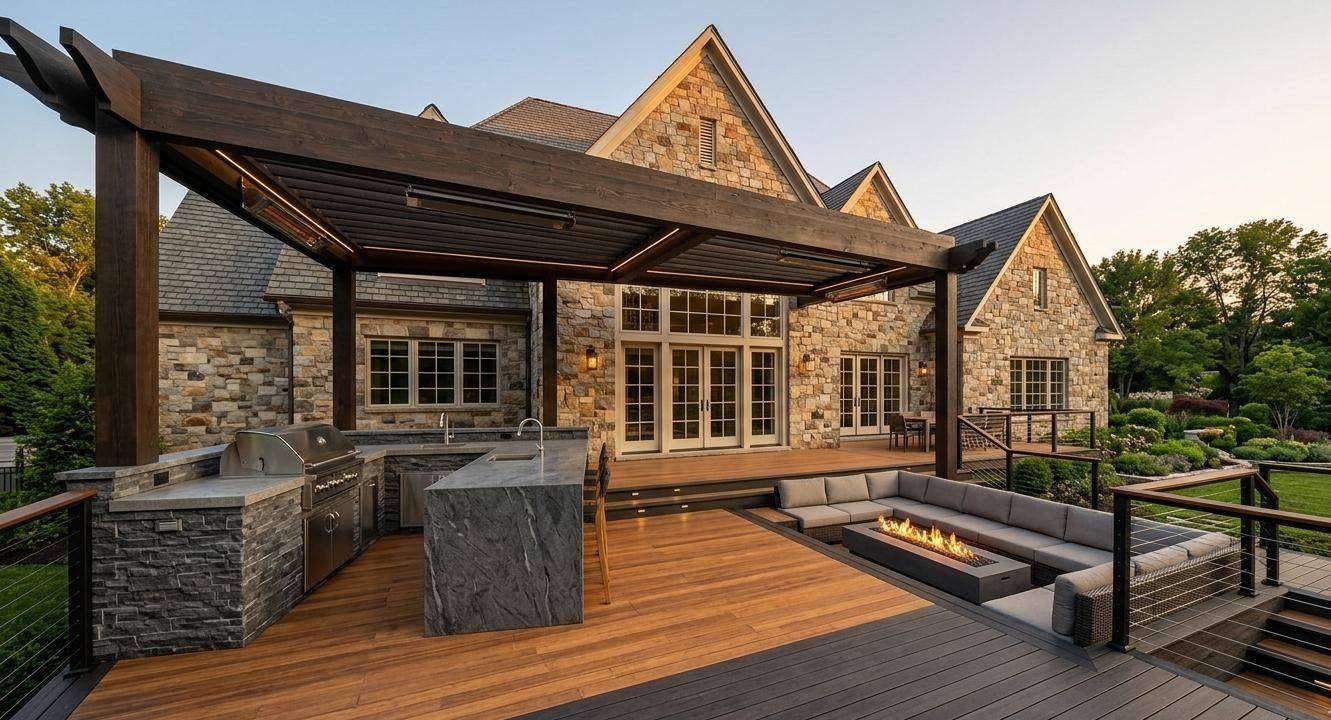
| Premium Multi-Level Build | $45,000 to $90,000+ | Multi-level deck with pergola or covered porch element, premium composite, cable or glass railings, built-in seating, integrated lighting, outdoor kitchen prep. 400+ sq ft with custom features. |
The Clarksburg and Germantown markets specifically run on the higher end of these ranges due to higher land values, larger average lot sizes and the bigger deck footprints common in 2000s-era subdivisions. Damascus, Laytonsville and Brookeville tend toward the middle of the ranges.
Get a Real Estimate for Your Deck
Generic ranges are useful for planning. An actual written estimate based on your existing deck condition, your goals and your yard is what you need to make a decision. Free, no obligation, response within 24 hours.
Permits and HOA Rules in Montgomery County
Any deck more than 30 inches above grade in Montgomery County requires a building permit. Most builder-grade decks on Clarksburg and Germantown homes qualify. Permits are not optional. They protect you at resale (most title searches now flag unpermitted structures), they protect you for insurance claims if anyone is injured, and they ensure the deck meets current code, which has tightened significantly since the 1990s and 2000s when most of these decks were originally built.
What changed in the code: ledger flashing requirements (your old deck likely fails this), lateral load connections, baluster spacing (most older decks have 6 inch spacing, current code requires 4 inch), and railing height (36 inches minimum, often higher). A reputable builder pulls the permit, schedules inspections, and signs off on each phase. If a contractor offers to skip the permit to save you a few hundred dollars, that is not a contractor you want to hire.
HOA rules vary by neighborhood. Clarksburg Town Center, Cabin Branch and Arora Hills each have specific exterior modification requirements. We handle the architectural review submission as part of the project when needed. Some HOAs restrict railing styles, color palettes and pergola heights. We have submissions on file for most major Clarksburg and Germantown HOAs.
How to Pick a Deck Builder in Clarksburg or Germantown
Most deck failures are not material failures. They are installation failures. A poorly attached ledger board, undersized joists, wrong spacing for composite, or missing flashing will fail no matter how good the boards are. When evaluating any builder, ask these questions:
- Are you licensed in Maryland? Required. Verify on the state license lookup before signing anything.
- Do you pull permits? If the answer is "we can if you want," walk away. A serious builder pulls permits on every job.
- Do you use subcontractors? Many deck builders sub the framing or the railing install to different crews. We use only our own in-house team. Here is why that matters.
- What spacing do you use for joists? For most composite, 16 inch on-center is required. For diagonal patterns, 12 inch. If the answer is 24 inch, they are building it like pressure-treated and the boards will sag.
- Do you install proper ledger flashing? Code requirement that is routinely skipped. Without it, water gets behind your siding and rots the house framing where the deck attaches.
- Can you show me three recent local projects? Composite looks different at 6 months versus 5 years. Recent local references show what their work actually looks like over time.
- What is the written warranty on your labor? Manufacturer warranty covers the boards. Your contractor's warranty covers the build.
Our Composite Deck Process
Every deck project we build in Clarksburg, Germantown and the surrounding areas follows the same four steps. No subcontractors, no shortcuts, no surprises in the final invoice.
Step 1: Free On-Site Assessment. We come to your home, measure the existing deck, inspect the structural condition of the framing and ledger, walk through composite color and brand options, and discuss any HOA considerations. No cost.
Step 2: Detailed Written Estimate. Itemized scope including demolition, framing work, decking, railings, stairs, lighting, permit fees and timeline commitment. Transparent line-item pricing. No hidden labor fees.
Step 3: Permits and Build. We file the permit, manage HOA approval if required, and start construction once approved. The same in-house crew handles demolition, framing, deck installation, railings and finish work. No rotating subs.
Step 4: Inspection and Walkthrough. County inspector signs off, we walk you through every detail, you load-test the railings yourself, and we are not done until you are completely satisfied. Full written warranty on the workmanship.