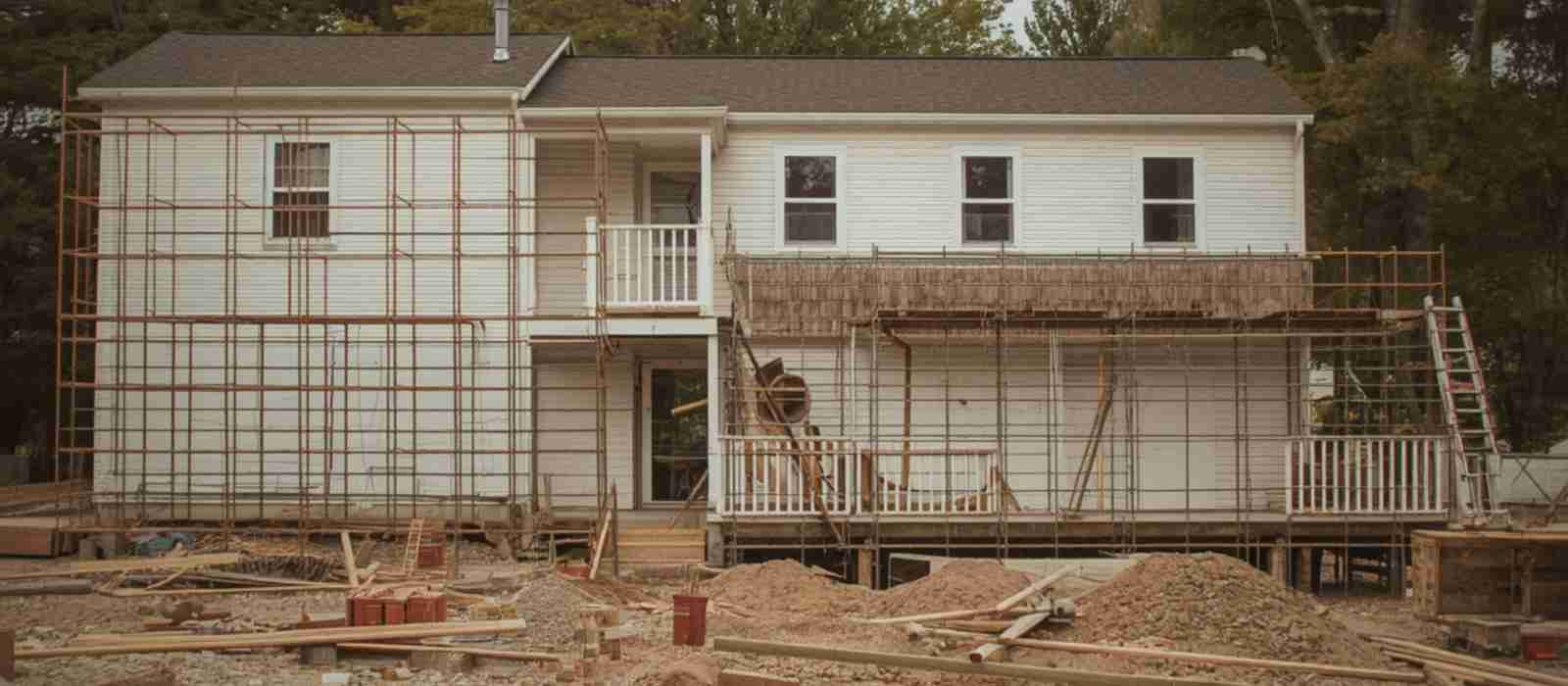
There is a specific moment in every multi-trade home project where the homeowner who decided to manage their own subcontractors realizes the math did not work out the way it looked on the spreadsheet. It is usually around week 4 or 5. The plumber finished rough-in but the electrician cannot start until tomorrow afternoon. The drywall crew is booked for Tuesday but the electrical inspection is not until Wednesday. The countertop template was already taken before the sink rough-in moved an inch and a half to the left. Nobody told the painters about the new backsplash height.
None of this would have happened with a true general contractor. All of it happened because the homeowner thought they were saving 20 percent. This guide walks through the actual financial comparison, the hidden costs nobody mentions, and how to tell whether the "general contractor" you are interviewing is actually full-service or a paper company that will assemble the same group of subs you could have hired yourself.
The Two Models You Are Actually Choosing Between
The conversation about "GC vs no GC" misses a layer. There are really three options in Maryland: hire a full-service general contractor, hire a paper general contractor, or manage your own subs. The first and third are honest paths. The middle one is where most homeowners end up by accident.
Full-Service General Contractor
Employs its own crews in the major trades. Carries its own workers comp insurance for those employees. Maintains direct authority over scheduling, sequencing, quality control and warranty. The same crew you meet on day one finishes your project. Common in remodeling firms that have been around 10+ years and built reputational equity worth protecting.
Paper General Contractor
Holds an MHIC license but operates as a sales and project management layer over a rotating cast of 1099 subcontractors. Markets itself as a general contractor, signs the contract, then assembles whichever subs are available for your specific project. Often the cheapest "GC" quote you receive. Often produces the worst project outcomes because the GC has limited control over the people actually in your home.
Owner-Managed Subs
You sign separate contracts with each tradesperson and coordinate them yourself. Eliminates the GC markup. Adds your time, your liability exposure, and your responsibility for every coordination decision. Works for specific people in specific situations, but not for most.
The Real Cost Comparison
Let us run honest numbers on a hypothetical $80,000 kitchen renovation in Germantown to show how the actual math plays out across the three approaches.
| Cost Component | Full-Service GC | Paper GC | Manage Your Own Subs |
|---|---|---|---|
| Direct labor & materials | $65,000 | $65,000 | $65,000 |
| Contractor markup | $15,000 (23%) | $12,000 (18%) | $0 |
| Your time managing | 5 hours | 25 hours | 120+ hours |
| Material markup loss | Included | Included | $2,500 to $5,000 (retail pricing) |
| Rework risk reserve | Covered by GC | Disputed often | Yours entirely |
| Warranty after completion | Single point of contact | Routed to subs | None aggregated |
| Quoted total | $80,000 | $77,000 | $65,000 |
| Realistic actual cost | $80,000 to $85,000 | $82,000 to $92,000 | $75,000 to $95,000 |
The actual cost ranges shift significantly because of three things almost nobody factors in upfront: material price markups when you buy at retail instead of contractor pricing, rework when one trade has to redo work the next trade made impossible, and change orders that accumulate without anyone holding a master scope.
The Hidden Costs of DIY Contracting
If you are leaning toward managing your own subs, here is the honest list of cost items you should budget that almost no online "DIY contractor" guide mentions:
- Retail material pricing. Subs typically pass through their trade pricing on material if they handle procurement. You buying materials retail at Home Depot or Lowe's adds 8% to 25% to material spend.
- Permit fees and runner costs. Every permit you pull yourself costs your time. Multiple permits across electrical, plumbing and HVAC for a kitchen alone can require 8 to 15 hours of administrative work.
- Insurance premium impact. Some homeowners insurance policies have language excluding coverage for damage caused during owner-managed major renovations. Verify before you start. BBB consumer protection resources note this is one of the most common claims-denial reasons.
- Coordination failures. The single largest hidden cost. When the plumber and electrician collide, somebody loses a day. When drywall goes up too soon, somebody pulls it back down.
- Inspection re-trips. Failed inspections require re-inspection, which requires re-scheduling subs, which causes more downstream delays.
- Change-order capture. Without a GC tracking changes, scope creeps and nobody is keeping a master log. You typically spend 8% to 15% more than the original budget without ever seeing the increases itemized.
A typical multi-trade home renovation requires 80 to 200 hours of active coordination across a 6 to 16 week project window. Phone calls, scheduling, on-site meetings, material runs, problem solving, dispute mediation. If your hourly value is $50 or higher, the GC markup nearly always returns positive ROI compared to losing that time on contractor logistics.
The Coordination Problem Nobody Sees Coming
Trade sequencing is not intuitive until you have done it five or six times. Here is the simplified sequencing for a standard kitchen renovation. Every step depends on the one before it being complete and inspected:
- Demolition and waste removal
- Framing changes if any
- Plumbing rough-in (water lines, drains, vents)
- Electrical rough-in (circuits, boxes, low voltage)
- HVAC modifications if any
- Inspection of all rough-in work
- Insulation
- Drywall hang and finish
- Prime and first paint coat
- Flooring underlayment and installation
- Cabinet installation
- Countertop template, fabrication, install
- Backsplash tile
- Plumbing trim out (faucets, disposal, etc)
- Electrical trim out (devices, fixtures)
- Appliance install
- Final paint touchups
- Final inspection
Every single one of those steps requires a different person or crew. Most of them require permit-related verification before the next step can begin. Skipping or rearranging this sequence creates rework that no homeowner notices until they receive a $4,000 invoice from a sub to redo work the next sub made impossible.
Liability and Insurance Gaps
This is the part most often skipped in DIY contractor discussions, and it can be the single largest financial exposure. When you act as your own general contractor in Maryland, you take on three liability layers:
Worker injury. If a 1099 subcontractor's worker is injured on your property and the sub does not carry adequate workers compensation insurance, the injured worker can come after you as the project organizer. Most homeowners insurance policies specifically exclude this scenario.
Property damage cascade. If the plumber's mistake causes the electrician's work to fail, your subs will point at each other. Without a GC, you are the only one holding all the contracts and you become the arbitrator and often the payer.
Code compliance. As the property owner pulling permits, you are legally responsible for ensuring the work meets Maryland code. Permit-pulling homeowners in Montgomery County have been held personally liable for code violations years after project completion.
A full-service general contractor carries general liability insurance, workers compensation for their employees, and an MHIC bond. Verify all three on every contractor through the Maryland MHIC license lookup before signing anything.
Talk to a Real General Contractor
If you are weighing whether to manage your own subs or hire a true full-service contractor, the easiest way to decide is to get an actual itemized quote. We will lay out scope, sequencing, timeline and pricing in writing so you can compare apples to apples. Free, no obligation.
The Paper GC Trap
The most expensive mistake we see is hiring a "general contractor" who turns out to be a sales operation with no in-house crews. You get all the cost of using a GC plus all the coordination problems of managing subs, because the GC is also juggling them across multiple projects.
Warning signs to watch for:
- The estimator who came to your home is not on-site during the project
- The crews change between phases (one team for demo, different team for framing, different team for finish work)
- Workers do not identify themselves as employees of the company that signed your contract
- Vehicles on-site have multiple company logos or no company logos
- Quality varies significantly between phases of the same project
- Warranty claims after completion get routed to the original sub, not the GC
- The GC takes longer to return calls during construction than during sales
None of these alone are conclusive. A pattern of three or more usually indicates a paper GC.
When Managing Your Own Subs Actually Works
The DIY contracting approach is the right answer in specific situations and we will tell you so honestly. Three scenarios where it works:
- Single-trade work. A simple water heater swap, a single replacement window, a fence install. No coordination needed. Hire the specialist directly and save the GC markup.
- You are in the construction industry. If you are a project manager, architect, engineer, real estate developer or active flipper, you have the skills and relationships. The GC markup is paying for capabilities you already have.
- Very small project budget with abundant time. $5,000 to $15,000 scope, you have flexible time, you accept the additional risk. The GC markup may not pencil out at that scale.
For anything multi-trade above $25,000 (which includes most kitchens, full bathrooms, additions, basement finishes, exterior work, full roofs and major decks), the math almost always favors a true general contractor unless you fall into one of the three buckets above.
How to Vet a True Full-Service General Contractor
Ask these questions of any contractor calling themselves a general contractor. The answers tell you which model they actually run.
- Are the people working on my home your W-2 employees or 1099 subcontractors? Honest answer is usually "mostly employees" or "all employees" for full-service. Pivots and qualifiers indicate paper GC.
- How long has your core crew been with the company? Looking for tenure of 3+ years.
- Can I visit one of your active job sites? A real contractor with happy clients can almost always arrange this.
- What is your subcontractor policy? Some full-service GCs sub specific trades (HVAC, electrical) - that is fine if disclosed and consistent. Surprising mid-project subcontracting is not.
- Who is my point of contact during construction? Looking for a named project manager, not "whoever picks up the office phone."
- Show me your MHIC license and certificate of insurance. Required. Verify the MHIC number against the state lookup.
- What is your written warranty? Looking for minimum 1 year on labor and workmanship from a true full-service contractor, plus pass-through of manufacturer warranties on products.
- Can you provide three local references from the last 12 months? Recent and local matters.
The cleaner the answers, the more likely you are dealing with a real full-service operation. Cliffbrook's zero subcontractor policy exists because we have watched the alternative play out hundreds of times across Montgomery County and it consistently produces worse outcomes for the homeowner.