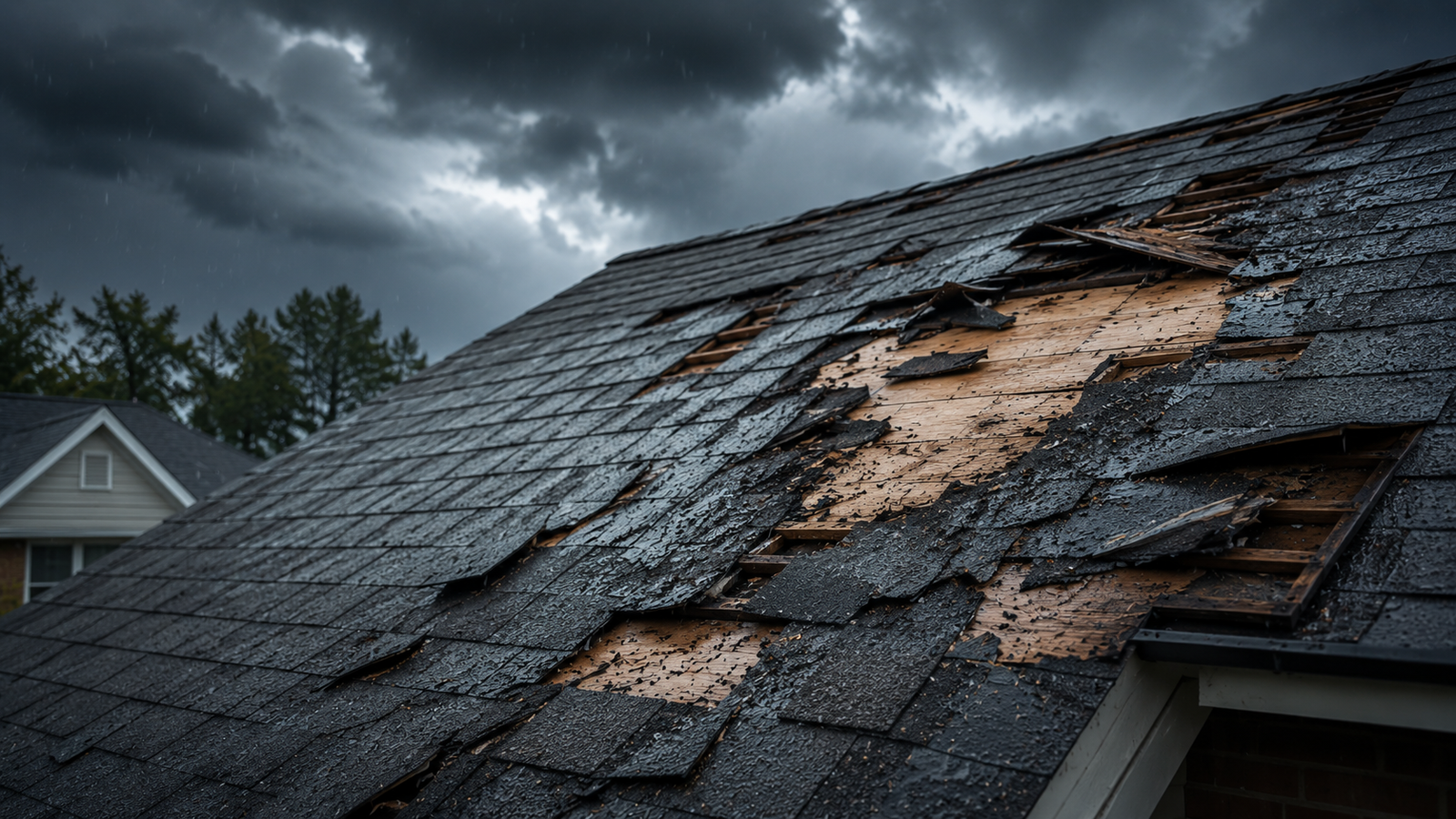
Montgomery County sees its share of severe weather every summer. Straight-line winds, sudden hail and the occasional fast-moving derecho can pass over Gaithersburg, Rockville, Germantown and Damascus in twenty minutes and leave behind damage that takes weeks to reveal itself. The trees stop swaying, the sun comes back out, and the roof looks fine from the driveway. That is exactly the problem.
The damage that drives the most expensive roof storm damage repair jobs we handle is rarely the missing shingle anyone can see. It is the lifted tab, the broken adhesive seal, the bruised shingle mat and the dented flashing that quietly let water past the surface. By the time a brown ring appears on a bedroom ceiling, water has often been tracking through the decking and insulation for a while. Catching the signs early is the difference between a small repair and a full storm damage restoration.
Why Hidden Storm Damage Is the Dangerous Kind
A roof is a system of overlapping layers designed to shed water. Storms do not have to rip that system apart to defeat it. They only have to break the seal. When high wind lifts a shingle and the self-sealing adhesive strip underneath snaps, the shingle can settle back down looking perfectly normal while no longer holding a watertight bond. The next heavy rain drives water underneath it.
According to the National Weather Service, thunderstorms are considered severe once winds reach 58 mph or hail reaches one inch in diameter, and Maryland routinely sees both during peak summer storm season. Those are exactly the conditions that break shingle seals and bruise asphalt without leaving obvious holes.
Left alone, a hidden leak does three things, all expensive: it rots the wood decking under the shingles, it soaks insulation so it stops insulating, and it creates the damp, dark conditions where mold grows. A roof problem that would have been a few hundred dollars in the first week becomes a structural and air-quality problem within a month. This is why a prompt post-storm inspection is one of the highest-value calls a homeowner can make.
The most common pattern we see across Gaithersburg, Rockville and Germantown is a homeowner who waited because nothing was visibly wrong. Three or four weeks after the storm, a ceiling stain shows up, and now the repair includes decking replacement and drywall, not just shingles. Almost every one of those jobs would have been far smaller and often fully covered by insurance if the roof had been inspected within days of the storm.
Wind Damage vs Hail Damage: Know the Difference
Maryland thunderstorms typically deliver two kinds of roof damage, and a single storm often does both. Knowing how each one shows up helps you describe what you are seeing when you call, and helps an adjuster connect the damage to the storm.
Wind damage lifts, creases and tears shingles and breaks the seal that holds them flat. Wind damaged shingles can look intact while being completely loose, which is why a close inspection matters. Wind also peels back ridge caps, loosens flashing around chimneys and vents, and flings tree limbs and debris that gouge the surface.
Hail damage shows up as round bruises or dents where impact knocks the protective granules loose and softens the shingle mat underneath. A proper hail damage roof inspection looks for those bruises on the shingles plus the easier-to-spot dents on soft metal: gutters, downspouts, vents and roof flashing. Where you can see hail dents in the gutters, the shingles almost always took hits too.
7 Signs of Hidden Roof Storm Damage
Here is what we check on every post-storm inspection across Montgomery County. You can spot a few of these from the ground safely, but the rest require a trained eye on the roof. Please do not climb a storm-damaged roof yourself.
1. Missing, Lifted or Creased Shingles
Obvious missing shingles are the easy ones. The hidden version is the shingle that got lifted by wind and laid back down with a horizontal crease across it or a broken seal underneath. Creased shingles are weak points that will fail in the next storm. Scan the roof line and field for tabs that sit slightly out of alignment with the rest.
2. Granule Loss in Gutters and Downspouts
Asphalt shingles are protected by a layer of mineral granules. Hail and wind-driven debris knock those granules loose, and they wash into the gutters. After a storm, check your gutters and the splash zone under the downspouts for piles of what looks like coarse black sand. Heavy granule loss exposes the asphalt to UV and accelerates failure even where no shingle is missing.
3. Hail Bruises and Dents
Hail bruises are round, dark spots where granules have been knocked away and the mat beneath is soft to the touch. They are hard to see from the ground but unmistakable up close. Confirm hail by checking softer surfaces first: dents on aluminum gutters, downspouts, roof vents, and AC unit fins all point to hail that also struck the shingles.
4. Damaged or Lifted Flashing
Flashing is the metal that seals the roof at its most vulnerable points: around chimneys, skylights, vents and in the valleys. Wind lifts and bends it, and once flashing is compromised, water gets in at the exact spots hardest to keep dry. Look for metal that is bent, separated from the surface, or missing sealant.
5. Interior Water Stains and Attic Moisture
The clearest interior warning of a leaking roof is a stain on a ceiling or wall, often a yellow or brown ring that grows. But check the attic too, with a flashlight, ideally during or just after rain. Damp insulation, water trails on the underside of the decking, daylight visible through the roof, or a musty smell all signal water is getting in even if no ceiling stain has appeared yet.
6. Dented Gutters, Vents and Downspouts
Soft metal records a storm better than shingles do. Dents and dings across gutters, downspouts, gutter aprons, and the metal hoods over roof vents are some of the most reliable evidence of hail, and they help an insurance adjuster date the damage to a specific event. Photograph them as part of your documentation.
7. Debris Impact and Soft Spots
Fallen branches and wind-blown debris can puncture or gouge a roof in a single spot that is easy to miss from below. On a roof, a trained inspector also feels for soft, spongy areas underfoot, which indicate the decking below has already started to absorb water. Soft decking means the leak is no longer hidden, it is established, and the repair scope grows accordingly.
Without leaving the ground, you can safely check for: shingles in the yard, granule piles under downspouts, dents in gutters and vents, sagging gutter lines, and ceiling or attic stains inside. If you see any of these after a storm, that is your cue to book a professional roof inspection, not to get on a ladder.
What to Do If Your Roof Leaks During Heavy Rain
If water is actively coming in during a storm, you are past inspection and into damage control. The goal is to limit how much gets into your home until a crew can tarp or repair the roof. Do these in order:
- Contain the water. Place buckets or bins under active drips, and lay down towels or a tarp to protect flooring and furniture. Move electronics and valuables out of the area.
- Relieve a bulging ceiling. If a ceiling is sagging or bubbling with trapped water, place a bucket underneath and carefully pierce the center with a small screwdriver to let it drain in a controlled spot. A controlled hole is far better than the whole ceiling collapsing.
- Kill power to the affected area. If water is anywhere near light fixtures or outlets, switch off that circuit at the breaker. Water and electricity together are the real danger in a roof leak.
- Document as you go. Photograph and video the active leak, the source if you can see it, and the interior damage. Timestamped evidence is gold for an insurance claim.
- Call for emergency roof repair. Do not wait for the storm to fully pass. The sooner a tarp goes on, the less interior damage you absorb. Call (240) 705-1650 for same-day emergency response in Montgomery County.
What you should not do is climb onto a wet, storm-damaged roof to find the leak yourself. Wet shingles are dangerously slick, the structure may be compromised, and roof falls are among the most serious home-repair injuries. Leave the roof to a crew with the right equipment.
Emergency Roof Tarping and Repair
When a roof is actively leaking or has exposed decking, emergency roof tarping is the first move, before any permanent repair. A properly installed tarp is anchored over the damaged area and the surrounding sound roof so wind cannot get under it, sealing the home against further water intrusion until materials and weather allow a lasting fix.
Fast tarping does two important things. First, it stops the clock on interior damage, which is where leak costs escalate fastest. Second, it demonstrates to your insurer that you took reasonable steps to mitigate the loss, which most policies require you to do. A homeowner who tarps promptly and documents it is in a far stronger position than one who let water run for two weeks.
From there, the permanent repair is scoped against what the inspection finds, anything from replacing a section of shingles and resealing flashing to a full roof replacement when the storm damage is widespread. We walk you through exactly what is damaged and what each option costs before any work begins.
Roof Leaking or Storm-Damaged Right Now?
Do not wait for the next rain to make it worse. We provide free post-storm inspections and same-day emergency tarping across Montgomery County. Honest assessment, written estimate, no pressure.
Roof Storm Damage Repair Cost in Montgomery County (2026)
Storm damage repair costs vary widely depending on the type of damage, the size of the affected area, and whether the underlying decking is involved. These are realistic 2026 ranges for Montgomery County based on our current project work. Remember that when damage is storm-related, much of this may be covered by your homeowner policy minus your deductible.
| Scope of Work | Typical Cost Range | What's Included |
|---|---|---|
| Emergency Tarping & Minor Repair | $400 to $1,500 | Emergency tarp over the damaged area, replacement of a small number of shingles, resealing of a lifted flashing or vent, leak stopped at the source |
| Section Repair / Moderate Storm Damage | $1,500 to $6,000 | Repair of a full roof slope or section, replacement of damaged decking, flashing and underlayment, gutter repair, interior leak source corrected |
| Full Storm Damage Restoration / Replacement | $9,000 to $25,000+ | Complete tear-off and roof replacement after widespread wind or hail damage, new decking as needed, new flashing, ridge vent and gutters, full warranty |
The biggest cost drivers are the amount of decking that has to be replaced, the roofing material, and roof pitch and access. The single best way to keep costs down is speed: catching damage early often keeps you in the first or second tier instead of the third. For a deeper look at how we handle roofing as a full-service crew, see our guide on why hiring a full-service GC beats juggling subcontractors.
How to Claim Insurance for Roof Storm Damage
Most Maryland homeowner policies cover sudden, accidental storm damage from wind and hail. They do not cover ordinary wear and tear or damage from deferred maintenance, which is why prompt action and good documentation matter so much. We are roofing contractors, not insurance agents, so confirm your specific coverage with your carrier, but here is the process that gives claims the best chance.
- Document immediately. Photograph and video everything as soon as it is safe: damaged shingles, dented gutters, debris, interior stains and leaks. Note the date and time of the storm.
- Prevent further damage. Arrange emergency tarping right away. Keep receipts for any temporary repairs, as those are typically reimbursable and show you mitigated the loss.
- Get a professional inspection and estimate. An adjuster works from documentation. A written inspection report with dated photos and an itemized estimate gives them a clear, defensible basis for the claim. We provide exactly this.
- File promptly. Report the claim to your insurer as soon as possible and ask about your policy's filing deadline. Many policies require claims within a year of the storm, and some are shorter.
- Be cautious with storm chasers. After big storms, out-of-town crews flood the area pressuring homeowners to sign on the spot. Work with a licensed, local, insured contractor who will still be here for warranty work, not one operating out of a truck for the season.
The Insurance Information Institute offers a helpful overview of the homeowner claim process if you want to understand the carrier's side before you file.
We provide a detailed written inspection report, dated before-and-after photos, an itemized scope of work and emergency-repair receipts, all formatted so an adjuster can work from them directly. Whether your claim is approved is between you and your carrier. We make sure the documentation is thorough and ready.
How to Choose a Storm Damage Roofing Contractor
Storms bring out the best and worst in the roofing business. The same week your neighborhood gets hit, unlicensed crews show up offering to "handle the whole thing with insurance." Some do shoddy work and disappear; some are outright scams. Ask any contractor you are considering:
- Are you licensed and insured in Maryland? Verify it. A storm-damage roof job done by an uninsured crew is a liability you do not want.
- Are you local and year-round? Local contractors are here for warranty work and reputation. Storm chasers are gone by fall. Ask for a local address and recent local references.
- Do you use subcontractors or your own crew? We use only our own in-house team on every job. Here is why that matters.
- Will you provide a detailed written inspection and estimate? A serious contractor documents the damage in writing, not with a vague verbal number scribbled on a card.
- Do you pull permits? Roof replacement in Montgomery County requires a permit. "We can skip it" is a red flag that creates problems at resale and with insurance.
- What is your written warranty? Get the workmanship warranty in writing, and confirm it stays valid if the company is still around to honor it.
Our Post-Storm Response Process
Every storm call we take across Potomac, Laytonsville, Gaithersburg and the rest of Montgomery County follows the same path, with emergency mitigation moved to the front when there is an active leak.
Step 1: Emergency Mitigation (if needed). If your roof is actively leaking, we prioritize getting a tarp on to stop water intrusion before anything else. The clock on interior damage stops here.
Step 2: Free Detailed Inspection. We get on the roof and into the attic, document every point of wind and hail damage with photos, and identify hidden damage that a ground-level look would miss. You get a clear written report.
Step 3: Written Estimate and Claim Documentation. Itemized scope, materials and timeline, plus the dated photo documentation and report your insurer needs. Transparent pricing, no hidden fees.
Step 4: Expert Repair with Our In-House Team. Every worker on your roof is a Cliffbrook employee. No rotating subcontractors. The same crew that inspects the roof is the crew that repairs it, backed by a written warranty.


