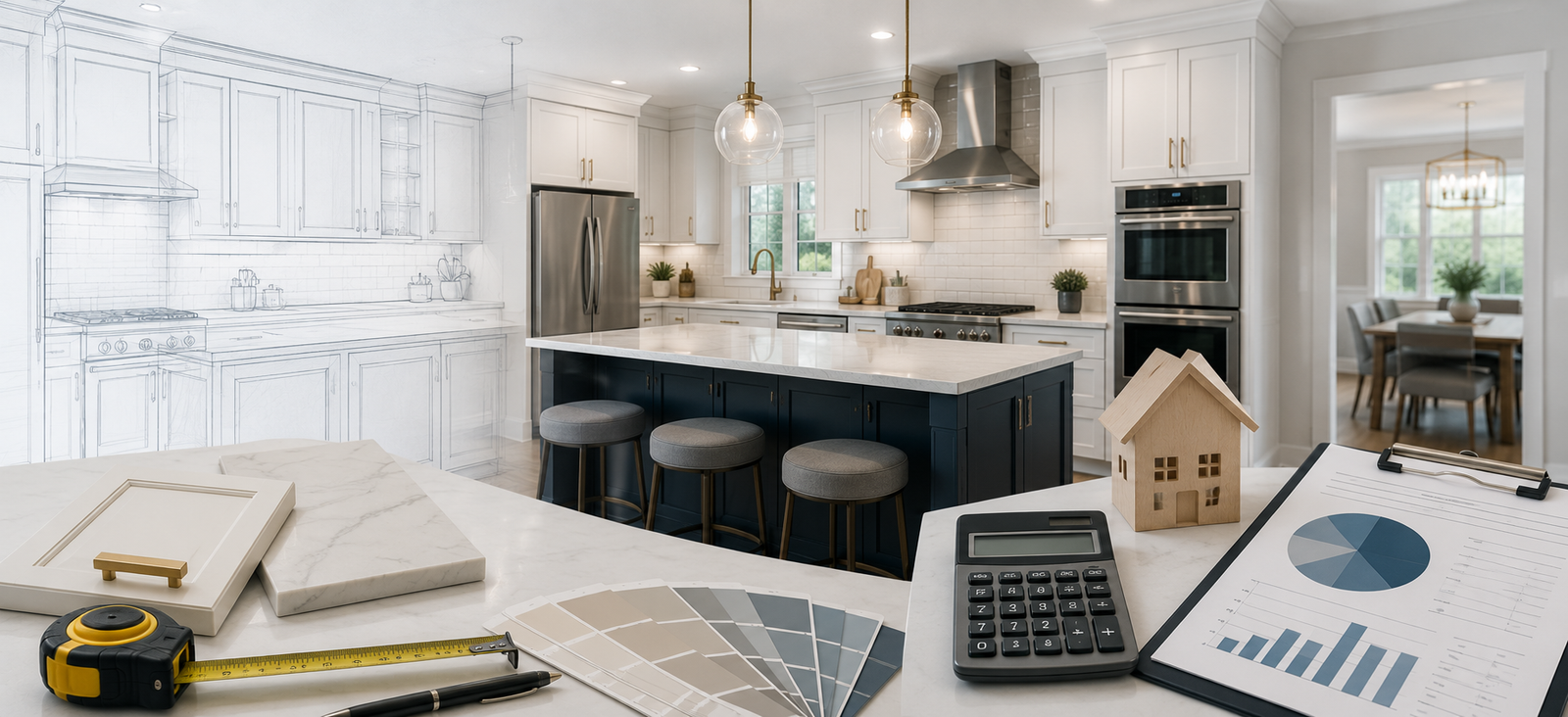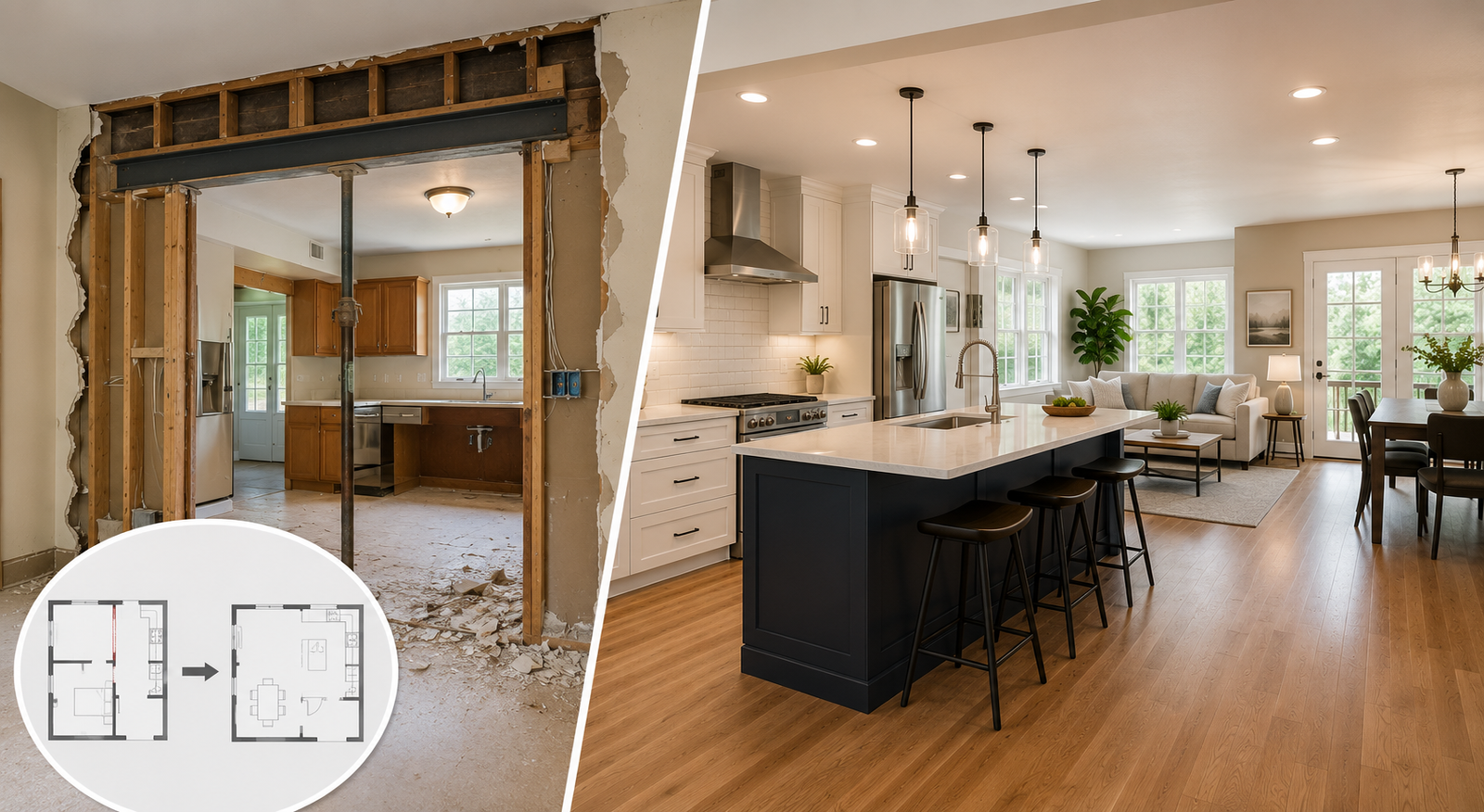
Every kitchen remodel eventually comes down to the cabinets. They typically account for the largest share of the budget, commonly around 30 percent and reaching 40 percent in cabinet-heavy layouts, which means the tier you choose moves your total project cost more than nearly any other single decision. Understanding the real differences between custom vs semi-custom cabinets (and stock) is how you avoid both overspending on capability you will not use and underspending on quality you will regret.
The three tiers are not just three price points. They differ in how they are built, what they are made of, how much you can tailor them, and how long they take to arrive. Here is the honest comparison, from the perspective of a contractor who installs all three through our kitchen remodeling service.
The Three Tiers at a Glance
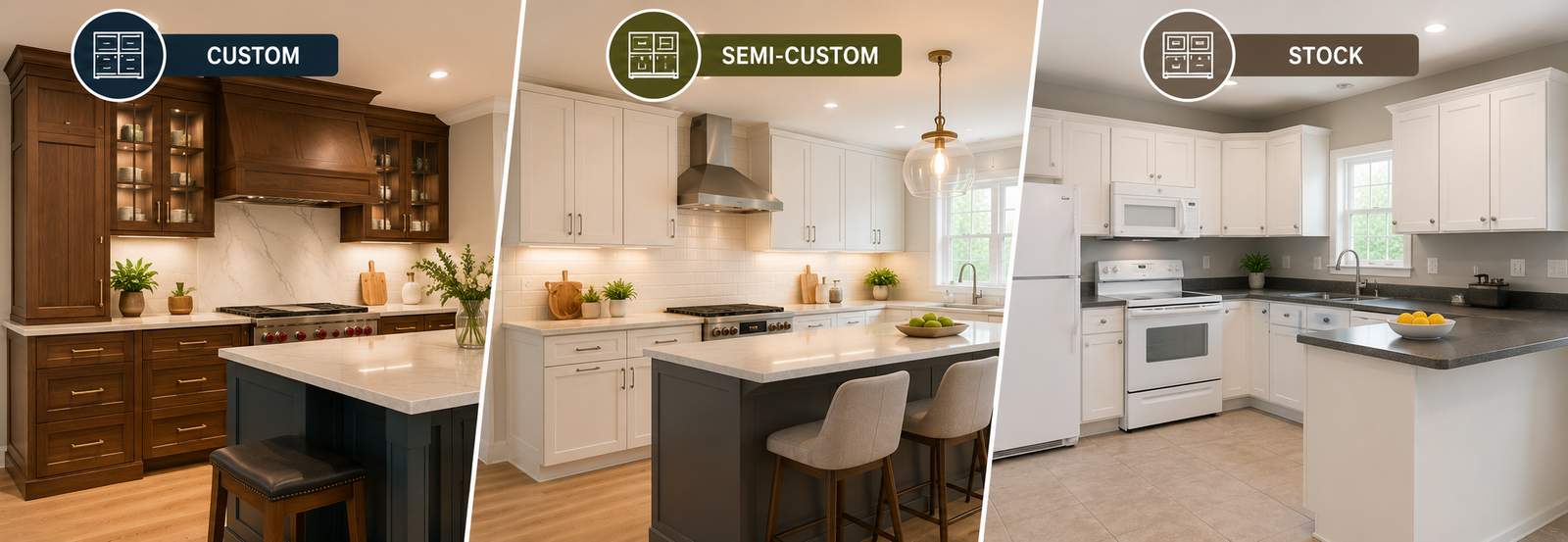
In one sentence each: stock cabinets are pre-made in standard sizes and finishes and sold ready to install; semi-custom cabinets are built on standard construction but offer wide choice in sizes, finishes and features; and custom cabinets are built from scratch to your kitchen's exact specifications with essentially unlimited options. Cost, quality and lead time rise as you move up the ladder. Which rung is right depends entirely on your kitchen, your priorities and your budget, which the rest of this guide will help you pin down.
Stock Cabinets
Stock cabinets are mass-produced in fixed sizes, usually in standard width increments, and a limited range of styles and finishes, then warehoused and sold ready to go. Because they are already made, they are the fastest and most affordable option.
Where stock shines: tight budgets, rental properties, quick refreshes, and standard kitchens where the available sizes happen to line up with your walls. When speed and cost lead the decision, stock does the job.
The tradeoffs: you fit your kitchen to the cabinets rather than the reverse, which often means filler strips to close gaps where standard sizes do not quite reach. Style and finish choices are narrower, and quality varies widely by brand, with lower-end stock frequently using particleboard boxes and basic hardware. It is a sound value when the fit is good, and a frustrating compromise when your kitchen has any unusual dimensions.
Semi-Custom Cabinets
Semi-custom is the sweet spot for the majority of Montgomery County kitchens, and where most of our mid-range projects land. These cabinets start from standard construction but open up real choice: you can modify dimensions within set increments, choose from a broad menu of door styles, finishes and wood species, and add storage and organization features. Better lines offer plywood boxes, dovetailed drawer boxes and soft-close hardware, often as standard rather than upgrades.
Where semi-custom shines: almost any typical kitchen where you want the space to feel tailored, quality construction, and control over the look, without paying full custom prices. For most homeowners, it delivers everything they actually need.
The tradeoffs: you are still working within a system, so genuinely unusual dimensions or a very specific vision can hit the limits of what the line offers. Lead times are longer than stock, typically several weeks, because the cabinets are built to your selections rather than pulled from a warehouse.
Custom Cabinets
Custom cabinets are built from scratch to your kitchen's exact measurements, with no meaningful limits on dimension, material, finish or configuration. This is the highest tier for construction quality and design freedom, and the only one that can perfectly fit an unusual space or realize a fully bespoke design.
Where custom shines: kitchens with unusual dimensions, angles or ceiling heights where stock and semi-custom sizes would waste space; a specific design vision or a wood species and finish the semi-custom lines cannot match; and high-end renovations where a fully tailored result is the goal. In larger premium homes, custom often fits both the space and the budget.
The tradeoffs: it is the most expensive tier by a wide margin, and the longest to produce, since everything is built to order. Custom is worth it when your kitchen has a real problem that only custom solves. It is an overspend when a standard kitchen would look and perform nearly the same in semi-custom.
Kitchen Cabinet Cost Comparison
Here is the kitchen cabinet cost comparison as installed in the Montgomery County market, with a typical 20-to-30-linear-foot kitchen for context:
| Tier | Cost / Linear Foot | Typical Kitchen | Lead Time | Best For |
|---|---|---|---|---|
| Stock | $100 – $300 | ~$2,500 – $7,500 | Days to ~3 wks | Budget, rentals, quick refreshes, standard sizes |
| Semi-Custom | $200 – $650 | ~$5,000 – $16,000 | ~4 – 8 wks | Most homeowners, tailored look, quality build |
| Custom | $500 – $1,200+ | ~$12,500 – $30,000+ | ~8 – 16 wks | Unusual spaces, bespoke design, high-end homes |
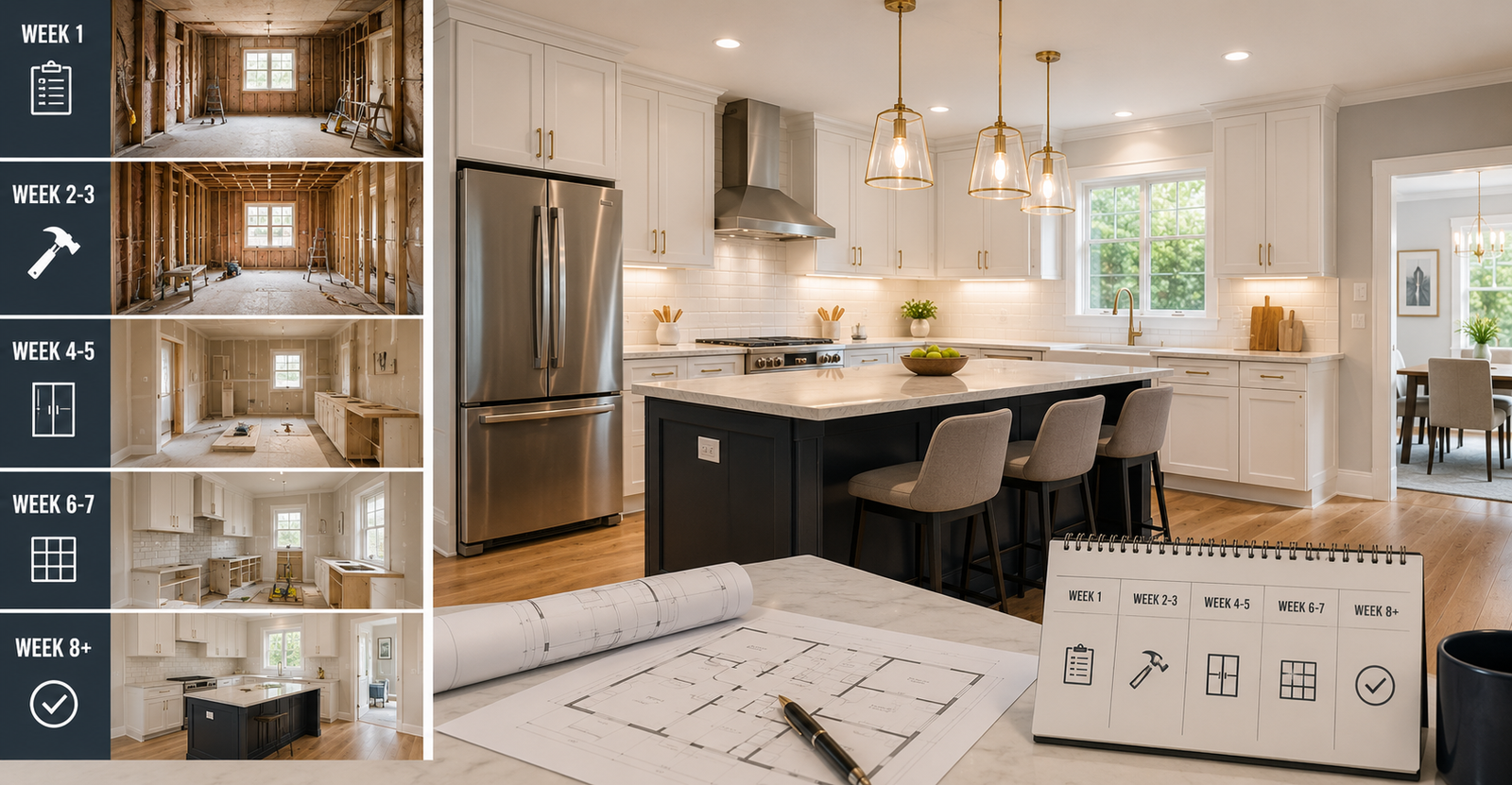
Those lead times matter for scheduling: demolition should be timed around confirmed cabinet delivery so the kitchen is not sitting torn apart waiting on a backordered box, which is one of the sequencing points we cover in our kitchen remodel timeline guide. And since cabinets are only one part of the overall number, see our complete kitchen remodeling cost guide for how the cabinet line fits into a full budget alongside countertops, labor and appliances.
If your existing cabinet boxes are structurally sound, you may not need new cabinets at all. Refacing, new doors, drawer fronts and matching veneer over the existing boxes, delivers a visually new kitchen at roughly 40 to 50 percent of replacement cost, and repainting quality cabinets costs even less. Paying for full replacement when refacing would do is one of the most common ways homeowners overspend on a kitchen. It is always worth having the existing boxes assessed before assuming you need to replace them.
What Actually Differs: Quality & Construction
Price aside, the real cabinet quality differences live in construction details most showroom visitors never inspect. These are what separate cabinets that last decades from cabinets that sag, swell and loosen in a few years:
- Box material. Plywood boxes (stronger, lighter, moisture-resistant, hold screws well) versus particleboard or MDF boxes (cheaper, heavier, vulnerable to moisture). This is the single most important quality marker.
- Drawer box construction. Solid-wood, dovetailed drawer boxes versus stapled or glued particleboard boxes. Dovetail joints hold up to a lifetime of opening and closing; cheap boxes work loose.
- Drawer glides. Full-extension, undermount, soft-close glides versus basic side-mount glides that only pull partway out and wear quickly.
- Hinges and hardware. Adjustable, soft-close hinges versus basic hardware that loosens and sags over time.
- Construction style. Frameless (full-access) versus face-frame construction, plus the thickness of the back panel and how the cabinet is joined, all of which affect strength and longevity.
Stock, semi-custom and custom do not map perfectly onto quality, a top-tier semi-custom line can be built better than entry custom, and premium stock can outperform bargain semi-custom. Rather than assuming the tier tells you the quality, look at these specific construction points on any cabinet you are considering.
Cabinet Materials Explained
Cabinet materials confuse a lot of homeowners, largely because of one persistent myth. Here is the straight version:
The Box
- Plywood is generally the best box material: strong, relatively light, holds fasteners well, and more resistant to moisture, which matters near sinks and dishwashers.
- Particleboard is the cheapest and most common in stock and budget lines. It works, but it is heavy and swells if it gets wet.
- MDF is dense and smooth, heavier than plywood, and used for both boxes and (especially) painted doors.
Doors & Drawer Fronts
- Solid wood is beautiful for stained finishes but can expand, contract and crack with humidity swings.
- MDF is actually superior for painted cabinets: no grain, no joints to crack, and a smooth finish, which is a real advantage in Maryland's humid climate.
- Wood veneer, thermofoil and laminate each offer durable, cost-effective looks over a stable core.
"Solid wood everywhere" is not the mark of quality it is assumed to be. The best cabinet boxes are usually plywood, not solid wood, and for painted doors, MDF resists cracking better than solid wood because it has no grain and no joints to open up. If you are staining, solid-wood doors make sense. If you are painting, do not pay extra for solid wood in the belief that it is automatically better, it often is not.
Soft-Close & Storage Features
Soft-close cabinets have become close to standard on better lines, and for good reason. Soft-close hinges and glides use a built-in damper so doors and drawers close gently and quietly instead of slamming, which is both a daily quality-of-life upgrade and a durability one, since eliminating slamming reduces wear over years of use. On many semi-custom and custom lines it is included; on lower-end stock it may be an add-on or unavailable.
Related features that separate a merely updated kitchen from one that works better every day:
- Full-extension drawers that pull all the way out so you can reach the very back.
- Deep pot-and-pan drawers that store more, and more accessibly, than base-cabinet doors.
- Pull-out shelves, lazy Susans and corner solutions that reclaim otherwise dead space.
- Drawer organizers, tray dividers and built-in inserts that keep everything in its place.
If budget forces a choice, these functional features are usually worth prioritizing over a more expensive finish, because you interact with them constantly.
Not Sure Which Cabinet Tier Fits Your Kitchen?
The right tier depends on your layout, your budget and how you use your kitchen, and an honest recommendation is worth more than a showroom pitch. We walk you through stock, semi-custom and custom for your specific space and tell you where your money is best spent. Free consultations across Cabin John, Potomac and all of Montgomery County.
Cabinet Installation: Where Quality Is Won or Lost
Even the best cabinets fail if they are installed badly, and this is where the cabinet installation step earns its keep. Cabinets have to be set perfectly level and plumb, securely fastened to wall studs, and scribed to the walls, which in older Montgomery County homes are almost never perfectly straight. Doors and drawers must be adjusted so reveals are even and everything opens and closes cleanly. Skilled installation is what makes good cabinets look and function like they should; sloppy installation turns quality cabinets into a kitchen full of crooked doors and uneven gaps.
This is a real argument for keeping design, ordering and installation under one accountable crew. When the people who measured and specified the cabinets are the same ones installing them, there is no gap between what was planned and what gets built, and no finger-pointing if something does not line up. That single-crew accountability is the same zero-subcontractor principle we apply across all our work, and in cabinetry it directly protects the finished result.
Are Custom Cabinets Worth the Money?
The honest answer: for most kitchens, no, semi-custom delivers the large majority of custom's quality and flexibility at a meaningfully lower cost, which makes it the smart money for a standard kitchen with standard needs. Custom becomes genuinely worth it in specific situations:
- Your kitchen has unusual dimensions, angles or ceiling heights where stock and semi-custom sizes would waste space.
- You have a specific design vision, wood species or finish that the semi-custom lines simply cannot match.
- You are doing a high-end renovation where a fully bespoke, perfectly fitted result is the goal, and the budget supports it.
The test is not whether custom sounds nicer, it always does. The test is whether your kitchen has a real problem that only custom solves. If it does, custom is money well spent. If it does not, semi-custom will look and perform nearly identically for meaningfully less, and that difference is better put toward countertops, appliances or simply staying on budget.
How to Choose the Right Tier
Run your kitchen through these five questions and the right tier usually becomes clear:
- What is your budget? Be honest about the total, then remember cabinets are commonly 30 percent or more of it.
- How long will you stay? Longer stays justify investing in better construction and features you will enjoy for years; short-term or rental situations point toward stock.
- Is your kitchen a standard shape? Standard rectangular layouts are well served by stock or semi-custom; unusual spaces push toward custom.
- How specific is your vision? A clear, particular design or finish the semi-custom lines cannot deliver is the main reason to go custom.
- What are your quality expectations? If durability and daily function matter to you, prioritize the construction details above over the tier label, and do not go below quality semi-custom.
Cabinets in Cabin John, Potomac and Across the County
Tier choices track the housing across our service area. In premium areas, a custom kitchen remodel in Cabin John MD and a high-end kitchen renovation in Potomac MD often call for custom cabinetry, larger homes, higher finish expectations, and spaces worth fitting exactly, and our luxury kitchen remodeling in Cabin John lives mostly in this tier. Across Germantown, Gaithersburg and much of the county's mid-range housing, semi-custom is the natural fit, delivering a tailored, quality result at a sensible cost. And in North Potomac, Chevy Chase and DC's northwest neighborhoods, projects span both tiers depending on the home and the goal.
Wherever your kitchen cabinets in Montgomery County MD project falls, the constant is honest guidance: the right tier for your kitchen is the one that fits your space, budget and how you actually live, not the most expensive one a showroom can sell you. That is how we approach every cabinet decision, family-owned, MHIC licensed, 75+ years of combined experience, and a strict zero-subcontractor policy that keeps design, ordering and installation under one accountable crew, so the cabinets you choose are the cabinets you get, installed the way they should be.