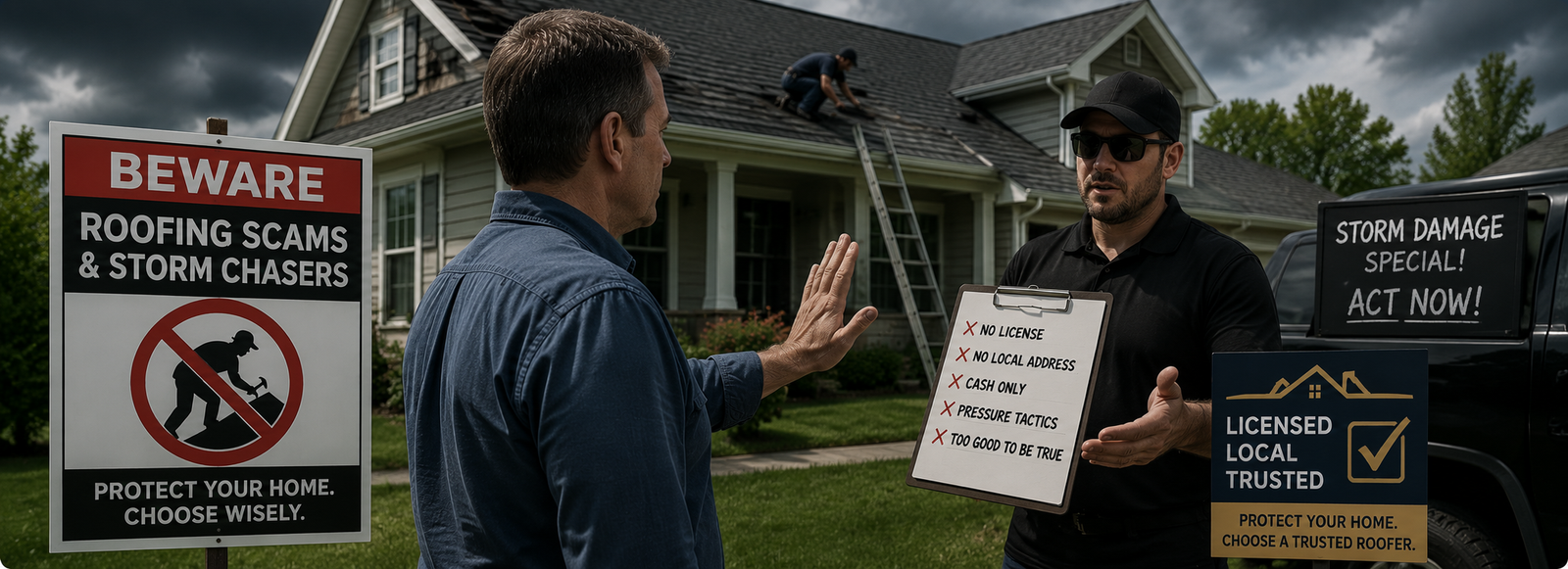
Roofing scams spike after every major storm, and Montgomery County is no exception. The county's own Office of Consumer Protection regularly warns residents about traveling contractors who descend on storm-hit neighborhoods. The tactics are predictable once you know them, and knowing them is your best defense.
This guide covers how roofing scams in Maryland work, the red flags that give scammers away, what Maryland law says about deposits, and how to make sure the roofer you hire is legitimate, licensed and local.
What "Storm Chasers" Actually Are
Storm chaser roofers are crews, often from out of state, that follow severe weather from region to region chasing quick insurance jobs. They arrive in force after a storm, sign up as many homeowners as they can, do the work fast, and move on to the next hard-hit area. They are built for volume and speed, not for standing behind their work.
Not every out-of-town crew is a scammer, and not every door-knocker is dishonest. But the storm-chaser model creates the problem: because they will not be here next year, they have little incentive to do quality work or honor a warranty. When a leak shows up six months later, the number on the contract is disconnected. That is the risk you are guarding against.
Why Roofers Knock on Doors After Storms
There is a simple economic reason behind the door-to-door roofing scams that follow storms. Damaged roofs plus insurance money equals a lot of available work in a short window, and door-knocking lets a crew sign the maximum number of homeowners before competitors, or the homeowners' own better judgment, catch up. Urgency is the tool: "Your neighbors are already signed up," "This offer is only good today," "The damage will get worse if you wait."
Legitimate local companies do sometimes canvass neighborhoods too, so a knock is not proof of a scam. It is simply your cue to slow down, ask questions, and verify before you sign anything. A real contractor will happily give you time. A scammer needs your signature before you can think.
Never sign a contract or hand over money on the same visit as an unsolicited knock. Every high-pressure tactic a storm chaser uses is designed to get your signature before you verify anything. Simply saying "I don't sign anything the same day, I'll verify your license and get back to you" defeats the entire playbook. Honest contractors respect it; scammers move on to an easier target.
The Biggest Roofing Contract Red Flags
Whether someone knocks on your door or you found them online, these roofing contract red flags should stop you cold:
- High-pressure, sign-today tactics and manufactured urgency.
- No MHIC license number, or reluctance to provide one.
- A large or cash-only deposit demanded upfront.
- An offer to waive or "eat" your insurance deductible, which can be insurance fraud.
- No written contract, or a vague one with no specific materials or scope.
- No proof of insurance (liability and workers comp).
- No local address or verifiable local references.
- A bid dramatically lower than everyone else, which usually means hidden corner-cutting.
- No written warranty.
Any one of these is a reason for serious caution. Several together mean walk away.
What Maryland Law Says About Deposits
Maryland has clear deposit rules for contractors that scammers routinely ignore. Under Maryland Home Improvement Commission regulations, a licensed home improvement contractor generally cannot require a deposit of more than one third of the total contract price before work begins.
So if a roofer wants half or all of the money upfront, especially in cash, before a single shingle is delivered, that alone is a red flag worth walking away over. Reasonable payment structures tie money to progress: a deposit within the legal limit, a payment when materials arrive or work starts, and the balance on satisfactory completion. Never pay the full amount before the work is done.
A deposit no larger than one third of the contract, a progress payment when materials are delivered or work begins, and the final balance only after the job is complete and you are satisfied. If a contractor's payment terms look nothing like this, ask why, and be prepared to walk.
How to Spot an Unlicensed Contractor
Many scams come down to one thing: unlicensed contractors doing work they are not qualified or accountable for. In Maryland, home improvement contractors, including roofers, generally must hold an MHIC license. Verifying it is the single most effective screen you have.
Ask for the MHIC number and look it up for free through the Maryland Department of Labor's license search. Confirm the license is active, matches the business, and has no troubling complaint history. A legitimate contractor gives you the number without hesitation. If they cannot or will not, that is your answer. For the complete vetting process, see our guide on how to choose a roofing contractor.
Skip the Guesswork. Hire Local and Verified.
We are a licensed, insured, family-owned general contractor with 75+ years of combined experience and a strict zero-subcontractor policy. We will hand you our MHIC number and insurance certificate before you ask. Free, no-pressure inspection across Montgomery County.
What to Do When Someone Knocks
If a roofer shows up unsolicited after a storm, here is a simple, safe script:
- Do not let them on your roof or into your home on the spot. You did not invite them, and you owe them nothing.
- Do not sign anything and do not pay any money during that first visit, no matter the pitch.
- Get their information: company name, MHIC license number, local address and phone.
- Verify the license yourself through the Maryland Department of Labor before any further contact.
- Get independent quotes from licensed local companies you found on your own, not just the one at your door.
- If you suspect damage, arrange your own inspection with a trusted local roofer on your timeline.
That is it. Slowing down costs you nothing and defeats nearly every scam.
If You Think You've Already Been Scammed
If you have already signed or paid and something feels wrong, act quickly. Gather all documentation, the contract, receipts, texts and photos, and stop any further payments. You can file a complaint with the Montgomery County Office of Consumer Protection and with the Maryland Home Improvement Commission, which handles complaints against home improvement contractors. The MHIC also administers a Guaranty Fund that may compensate homeowners for certain losses caused by licensed contractors, one more reason verifying a license before hiring matters so much, since an unlicensed scammer leaves you with far fewer options. A consumer protection resource or attorney can help you understand your next steps.
How to Hire a Trusted Local Roofer Instead
The opposite of a storm chaser is a company rooted in the community, one whose reputation depends on doing right by neighbors it will see again. When you look for a trusted roofing contractor in Montgomery County, favor:
- A verifiable MHIC license and current insurance.
- A real local address and a track record in the area, from Laytonsville to Brookeville and across the county.
- Its own in-house crew rather than rotating subcontractors.
- A detailed written contract, honest payment terms, and a written warranty.
- No pressure, and genuine references you can check.
That is exactly how we operate. If your roof took storm damage and you want an honest assessment rather than a hard sell, our guides on spotting hidden storm damage and roof insurance claims in Maryland are good next reads, and we are always glad to take a look through our roof and gutter service.