Ask ten people whether quartz vs granite countertops is the better choice and you will get ten confident, contradictory answers. That is because there is no single winner, only a winner for your kitchen. Both materials are premium, durable and beautiful; they simply trade strengths, and once you understand those trade-offs, the decision usually makes itself.
Here is the honest, no-agenda breakdown from a contractor who installs both through our kitchen remodeling service, priced for the Maryland market and written to help you decide rather than to sell you one over the other.
Quartz vs Granite vs Marble at a Glance
| Factor | Quartz | Granite | Marble |
|---|---|---|---|
| What it is | Engineered (ground quartz + resin) | Natural stone, quarried | Natural stone, quarried |
| Sealing | Never needs sealing | Every 1–3 years | Every 6–12 months |
| Stain resistance | Excellent (non-porous) | Good when sealed | Poor (etches, stains) |
| Heat resistance | Sensitive, use trivets | Excellent, handles hot pans | Good, but can mark |
| Durability | Very hard, scratch-resistant | Very hard, scratch-resistant | Softer, scratches/etches |
| Look | Consistent, huge range | Unique natural variation | Timeless veined elegance |
| Cost / sq ft installed | $70 – $150 | $80 – $150 | $80 – $250 |
| Best for | Low maintenance, busy kitchens | Heat, natural stone lovers | Design-first, accepts patina |
The short version: quartz wins on maintenance and stain resistance, granite wins on heat and natural durability, and marble wins on sheer beauty for those willing to care for it. All three read as premium in a Montgomery County kitchen. Now the detail behind each.
What Each One Actually Is
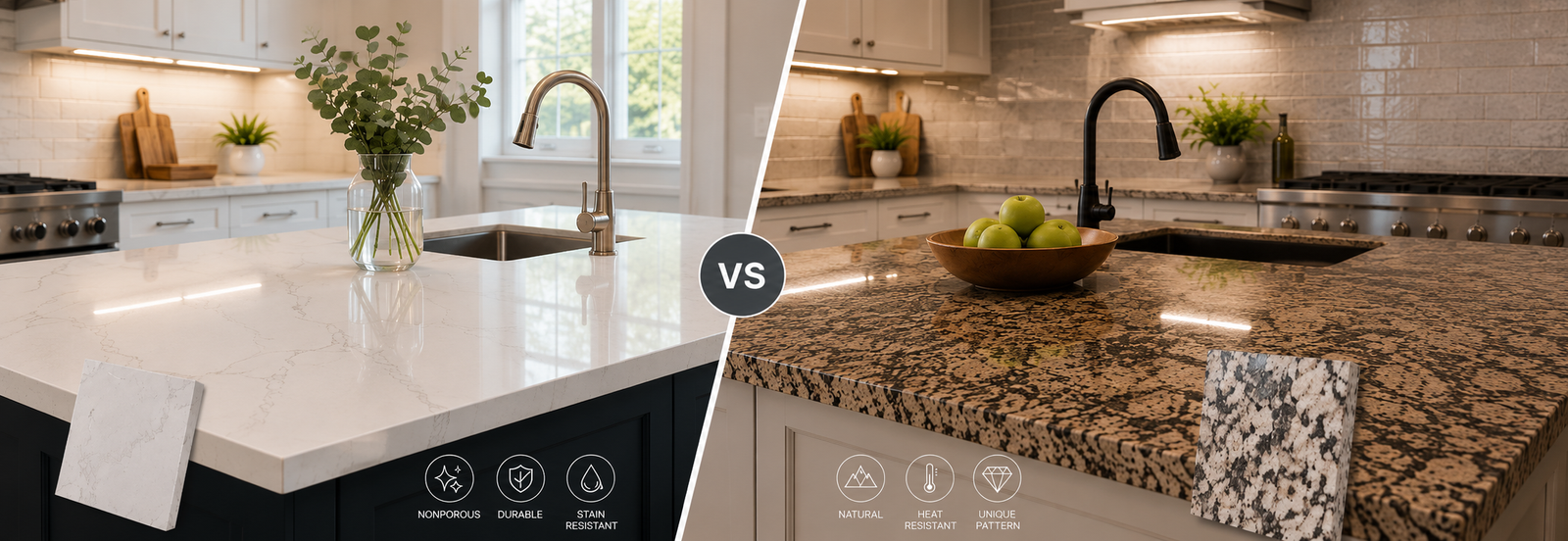
Quartz is engineered stone, made by combining roughly 90 to 95 percent ground natural quartz with resins and pigments, then forming it into slabs. That manufacturing is the source of all its properties: it is non-porous, its patterns are consistent and controllable, and its color range is enormous, including highly convincing marble and stone looks. The same resins that make it non-porous also make it heat-sensitive.
Granite is 100 percent natural stone, quarried and cut into slabs, so every slab is genuinely one of a kind, with natural mineral variation, movement and depth that manufactured surfaces imitate but do not truly replicate. Because it is natural stone, it is porous and needs sealing, but it is also naturally heat- and UV-resistant.
Marble is also 100 percent natural stone, a metamorphic rock prized for centuries for its luminous depth and soft, flowing veining, the classic white-with-gray Carrara and the bolder Calacatta and Statuario are the looks most homeowners picture. It is the most visually distinctive of the three, but it is softer and more porous, which makes it more prone to scratches, etching and stains. Marble is the choice when the look matters more than easy upkeep.
Marble & Quartzite: The Natural-Luxury Options
Marble countertops deliver a beauty the other materials can only imitate, which is exactly why they remain a signature of high-end kitchens. The trade-off is honest and worth understanding before you commit. Marble is porous and reactive: acidic foods and liquids like lemon, wine, vinegar and tomato can etch the surface (leaving dull marks) even when it is sealed, and it stains and scratches more easily than granite or quartz. It needs sealing roughly every 6 to 12 months, more often than granite. Many marble owners embrace this, the material develops a lived-in patina over time that they consider part of its character, and with proper care marble can last a lifetime. But if you want a bright-white counter that stays pristine with zero fuss, a marble-look quartz gets you the aesthetic without the maintenance. Marble makes the most sense on islands, baking stations or lower-traffic runs, or for homeowners who genuinely love the evolving look.
If you love the marble look but want more durability, quartzite is the option worth knowing about. Quartzite is a natural stone (not to be confused with engineered quartz) that often resembles marble's soft veining but is considerably harder and more scratch- and etch-resistant, closer to granite in toughness. It still needs periodic sealing as a natural stone, but less fussy than marble. Quartzite sits at the premium end of the price range, and for a Montgomery County kitchen that wants marble's elegance with better everyday performance, it is frequently the sweet spot. The one caution: some slabs sold as quartzite are actually softer stones, so buy from a reputable fabricator who can confirm what you are getting.
Durability & Everyday Use
Both are among the most durable countertop surfaces you can buy, and in a normal kitchen either will look great for decades. Quartz durability comes from its hardness and non-porous surface: it resists scratches, chips and stains extremely well and shrugs off daily use. Granite is likewise very hard and scratch-resistant, and adds superior heat tolerance.
The everyday-use differences that actually matter: quartz never absorbs a spill, so a glass of red wine left overnight wipes away, while unsealed granite could stain. Granite lets you set a hot pot down in a pinch, while quartz demands a trivet. Neither should be used as a cutting surface, cutting directly on either dulls your knives and can mar the finish. For most families, the deciding factor is not which is "tougher" (they are close) but which failure mode they would rather avoid: occasional resealing, or always reaching for a trivet.
Maintenance & Sealing
This is the biggest practical difference in daily ownership. Granite maintenance means periodic sealing, typically about once a year, though it varies by the specific stone and how hard the counter is used, to keep the porous surface resisting stains. The sealing itself is easy (wipe on, let cure), but it is a recurring task granite requires. A quick check: drop water on the surface, if it beads, the seal is good; if it soaks in and darkens the stone, it is time to reseal.
Quartz, being non-porous, never needs sealing, day-to-day care is just soap and water. If low maintenance is high on your list, this single difference often decides it. Both materials are easy to clean; the distinction is the ongoing sealing commitment that comes with natural stone.
If you want the lowest-maintenance surface and never want to think about sealing, lean quartz. If you love natural, one-of-a-kind stone and want to set hot pans down without a second thought, lean granite. If you have a sunny kitchen with strong direct light on the counters, granite avoids the fading risk quartz can have. Most other considerations are close enough that either choice will serve you well for decades.
Appearance & Style
Aesthetics are personal, but the two differ in a predictable way. Quartz offers consistency and range: because it is engineered, the slab you approve is the counter you get, patterns are uniform, and the color palette is vast, including whites, solids and marble-look designs that are hard to find or maintain in natural stone. Granite offers natural uniqueness: no two slabs are identical, and many homeowners specifically want that organic variation and depth. The flip side is that you should always view and approve the actual granite slab, since the sample will not match exactly, and that variation is a feature to some and a frustration to others.
Neither is more "high-end" than the other; both read as premium. It comes down to whether you prefer engineered consistency or natural character.
Countertop Cost Per Square Foot
Here is the countertop cost per square foot, installed, for kitchen countertops in Montgomery County MD, with the neighboring options for context. As a higher-cost Washington DC market, plan toward the upper part of each range. A typical kitchen has about 40 to 60 square feet of counter:
| Material | Installed Cost / Sq Ft | Notes |
|---|---|---|
| Laminate | $20 – $50 | Budget option, improved looks, lower durability |
| Butcher Block | $40 – $100 | Warm, natural wood; needs oiling |
| Granite | $80 – $150 | Natural stone, unique, seal every 1–3 yrs |
| Quartz | $70 – $150 | Engineered, non-porous, no sealing |
| Quartzite | $80 – $200 | Natural, marble look with more durability |
| Marble | $80 – $250 | Carrara ~$75–$150; Calacatta/Statuario higher |
Notice that quartz and granite overlap heavily, so the material category matters less than the specific slab, while marble and designer quartz brands (Cambria, Caesarstone, Silestone) push toward the top. What actually drives price to the high end: exotic colors and patterns, thicker slabs, elaborate edge profiles, and features like a waterfall island or slab-matched backsplash. Since countertops are one line among several in a kitchen, see how they fit alongside cabinets, labor and appliances in our complete kitchen remodeling cost guide, and note that countertop fabrication has a lead time of its own, which is part of the scheduling in our kitchen remodel timeline guide.
Comparing Countertops for Your Kitchen?
The best way to choose is to see and feel the actual slabs against your cabinets and light. We help you compare quartz, granite, marble and quartzite for your specific kitchen, then handle templating, fabrication and installation as one coordinated job. Free consultations across Potomac, Gaithersburg and all of Montgomery County.
Which Is Better for Resale?
For resale, the honest answer is that all three help and none hurts. In a competitive market like Montgomery County, buyers read quartz, granite or marble as the mark of an updated, quality kitchen, which is what genuinely moves offers, so having a premium stone counter matters more than which stone it is. Quartz has been the trendier pick lately and speaks to buyers who want low-maintenance, move-in-ready homes; granite retains broad, lasting appeal and strong buyer recognition (for many buyers, "granite countertops" is still shorthand for an upgraded kitchen); and marble signals luxury, especially in higher-end homes, though some buyers factor in its upkeep. In an affluent community, a marble or marble-look island can be a genuine selling feature.
If you are remodeling to sell soon, either is a safe, value-adding choice, and choosing a neutral, broadly appealing color matters more for resale than the material itself. If you are staying for years, pick the one you will enjoy living with, because the day-to-day experience of the two differs more than their effect on your eventual sale price.
Heat, Scratches & Stains
The practical wear differences, summarized:
- Heat. Granite handles hot pans; quartz can scorch or discolor from high heat because of its resins, so trivets are a must on quartz (and good practice on granite too).
- Scratches. Both are highly scratch-resistant, but neither should be cut on directly, use a cutting board to protect both the counter and your knives.
- Stains. Quartz is non-porous and highly stain-resistant with no upkeep; granite resists stains well when properly sealed but can absorb and stain if the seal lapses, especially lighter granites.
- Sunlight. Granite is UV-stable; quartz can fade over time in strong, direct sunlight, worth considering for counters under big south-facing windows.
Edge Profiles & Waterfall Islands
Two design choices meaningfully affect both look and cost. Edge profiles, the shape of the counter's edge, range from simple eased or straight edges to beveled, bullnose, ogee and mitered profiles; the fancier the profile, the more fabrication labor and the higher the cost. It is a small detail that noticeably changes the finished feel of the kitchen.
A waterfall island is where the countertop material continues vertically down the sides of the island to the floor, so the stone appears to cascade over the ends. It is a dramatic, high-end modern look, and it costs more for two reasons: it uses considerably more material, and it requires precise mitered seams at the corners so the pattern flows continuously. Waterfall ends work in both quartz and granite; quartz's consistent patterns make continuous flow easier to achieve, while a granite waterfall relies on careful slab and seam selection. If it is on your wish list, budget for the extra material and skilled fabrication, because the visual impact is among the biggest you can get in a kitchen.
Butcher Block & Other Options
Quartz and granite are not the only choices, and a mixed-material kitchen (say, stone perimeter with a butcher-block island) can be the best of both. Briefly:
- Butcher block countertops. Warm, natural wood at roughly $40 to $100 per square foot. Beautiful and comparatively affordable, but they need periodic oiling, can scratch and dent, and are vulnerable to water damage, best away from the sink or as an accent rather than the whole kitchen.
- Marble & quartzite. Premium natural stones. Marble is stunning but soft, it stains and etches and needs care; quartzite is extremely hard and durable. Both run higher, roughly $70 to $200+ per square foot.
- Laminate. The budget option at $20 to $50 per square foot, with far better looks than it used to have, though it cannot match stone for durability or resale appeal.
Countertop Installation
Whichever material you choose, countertop installation is a precise, three-stage job that determines how good the finished result looks. First, templating: exact measurement of your cabinets (often digitally) so the slab is cut to fit. Then fabrication: cutting the slab, shaping the edges, and making cutouts for the sink and cooktop. Finally installation: setting the heavy slabs level, placing and finishing seams, and securing everything with proper support.
Two things make or break it. The cabinets must be perfectly level, since stone will not forgive an uneven base, which is one reason countertop and cabinet work should be coordinated rather than split between disconnected crews. And seam placement matters aesthetically, a good fabricator locates seams thoughtfully and matches the pattern across them. Keeping measurement, cabinet installation and countertop work under one accountable crew, the zero-subcontractor way we run every project, is what ensures the counter fits the cabinets and the whole kitchen lines up as designed.
Kitchen Countertops in Potomac, Gaithersburg and Across the County
We supply and install kitchen countertops in Montgomery County MD in quartz, granite, marble, quartzite and every alternative above. Whether it is quartz countertops in Potomac MD, a granite installer in Gaithersburg MD, a luxury kitchen in Garrett Park (20896), or a counter swap anywhere else in the county, the approach is the same: we bring the material options to you, help you compare them against your cabinets and lighting, and handle templating, fabrication and installation as one coordinated job so the seams, edges and fit are right. Across Germantown, Olney and the rest of the county, the countertop decision comes up in nearly every kitchen we touch, and our answer is always the same, there is no universally "best" material, only the best one for your kitchen, your maintenance tolerance and your budget.
Whether you land on low-maintenance quartz, natural granite, timeless marble, or durable quartzite, the constant is honest guidance and precise installation. That is how we handle every countertop installation in Montgomery County MD, family-owned, MHIC licensed, 75+ years of combined experience, and a strict zero-subcontractor policy that keeps your cabinets and counters, and the critical fit between them, under one accountable crew from template to final seam.