A roof is one of the largest single checks most homeowners ever write to a contractor, and unlike a kitchen or a deck, you cannot inspect most of what you paid for, the water-protection layers that matter most disappear under the shingles forever. That is why choosing the contractor matters more in roofing than in almost any other trade: you are not really buying shingles, you are buying the judgment, credentials and process of the people installing them.
Fortunately, reliability leaves a paper trail. A genuinely licensed roofing contractor can be verified, documented and questioned before a single shingle is ordered. Here is exactly how, and what the answers should look like.
Licensing: The Non-Negotiable Starting Line
In Maryland, home improvement contractors, roofers included, must hold a license from the Maryland Home Improvement Commission (MHIC). In Washington DC, contractors must be licensed with the District's business licensing authority. These are not formalities. A license means the contractor met the state's requirements, can legally pull the permits your project needs, and answers to a regulator with a complaint process, and in Maryland, a guaranty fund, standing behind it.
The inverse matters just as much: an unlicensed operator cannot pull your permit (and will ask you to, or skip it), has no regulator to answer to, and typically cannot obtain proper insurance either. Every problem in this article gets worse when the contractor is unlicensed, which is why the license check is step one, before price, before schedule, before anything. Our own MHIC licensing appears on every estimate we issue, because that is where it belongs.
Bonded and Insured: What It Actually Protects
"Licensed, bonded and insured" gets said so often it blurs together, but each word protects you differently. A bonded and insured roofing company carries:
- General liability insurance, which pays if the contractor damages your property, a dropped beam through a skylight, an equipment mishap, a mistake that floods a room.
- Workers' compensation, which covers workers injured on your roof. Without it, an injured worker's claim can reach the homeowner, a risk few people realize they are accepting when they hire the cheap uninsured crew.
- Bonding, a financial guarantee behind the contractor's obligations, giving you a recovery path if the contractor fails to perform.
Ask for current certificates of insurance, and for real certainty, have them sent directly from the insurer, which confirms the policies are actually in force rather than expired paper. A reliable contractor treats this request as routine, because it is.
Verify Everything in Under Ten Minutes
One: run the MHIC license number through the commission's free online lookup, confirm it is active and matches the business name on the estimate exactly. Two: request insurance certificates for liability and workers' comp. Three: read the Google reviews, looking for volume, recency and how the company responds to problems, not just the star average. Four: confirm a real local address and a phone number that connects to the same business. Ten minutes, zero cost, and it filters out the majority of bad outcomes before they can happen. No legitimate contractor objects to any of it.
What to Ask a Roofing Contractor Before Hiring
Once the paperwork checks out, the interview separates good from merely legal. These six questions, and the shape of a good answer:
- "Who exactly will be on my roof?" The answer you want: our own employees. Subcontracted crews mean the company selling you the roof is not the one building it, and accountability fragments accordingly. Our answer is zero subcontractors, ever, and any contractor should answer this one without flinching.
- "What manufacturer certifications do you hold?" Certifications like CertainTeed Master Shingle Applicator require demonstrated installation competence and unlock enhanced warranties that uncertified installers cannot register. It is one of the few third-party quality signals in the industry.
- "Who pulls the permit?" Only acceptable answer: we do. A contractor asking you to pull your own permit is usually telling you they cannot.
- "What does your workmanship warranty cover, in writing?" Details below, but the phrase "in writing" is the test.
- "What is your quality control process during the job?" Vague answers here are the norm; a specific inspection process is the differentiator. More on this in a moment.
- "Can I see recent local projects and references?" Local roofing experts have local proof: addresses nearby, reviews from your county, photos of work you can drive past. Our reviews and project gallery exist for exactly this question.
For the fuller hiring walkthrough, including estimate comparison and contract terms, see our companion guide on choosing a roofing contractor in Montgomery County.
Roofing Warranties, Decoded
Roofing warranties come in two kinds, and homeowners are routinely surprised to learn which one matters more. The manufacturer's warranty covers material defects in the shingles, and its real strength depends on the installer: certified contractors can register enhanced versions with longer, broader coverage, while a standard installation gets standard terms, and installation errors void material coverage entirely.
The workmanship warranty covers the installation itself, and since the large majority of roof failures trace to installation rather than materials, this is the warranty that actually gets used. Read it for three things: how long it runs, what it specifically covers, and what conduct voids it. Be skeptical of impressive-sounding "lifetime" language with no written terms, and of long warranties from companies unlikely to exist long enough to honor them, a warranty is only as durable as the business behind it. A company that has been serving the same communities for years, under the same name, with the same phone number, is offering you a warranty that means something.
After the Storm: When Bad Actors Come Knocking
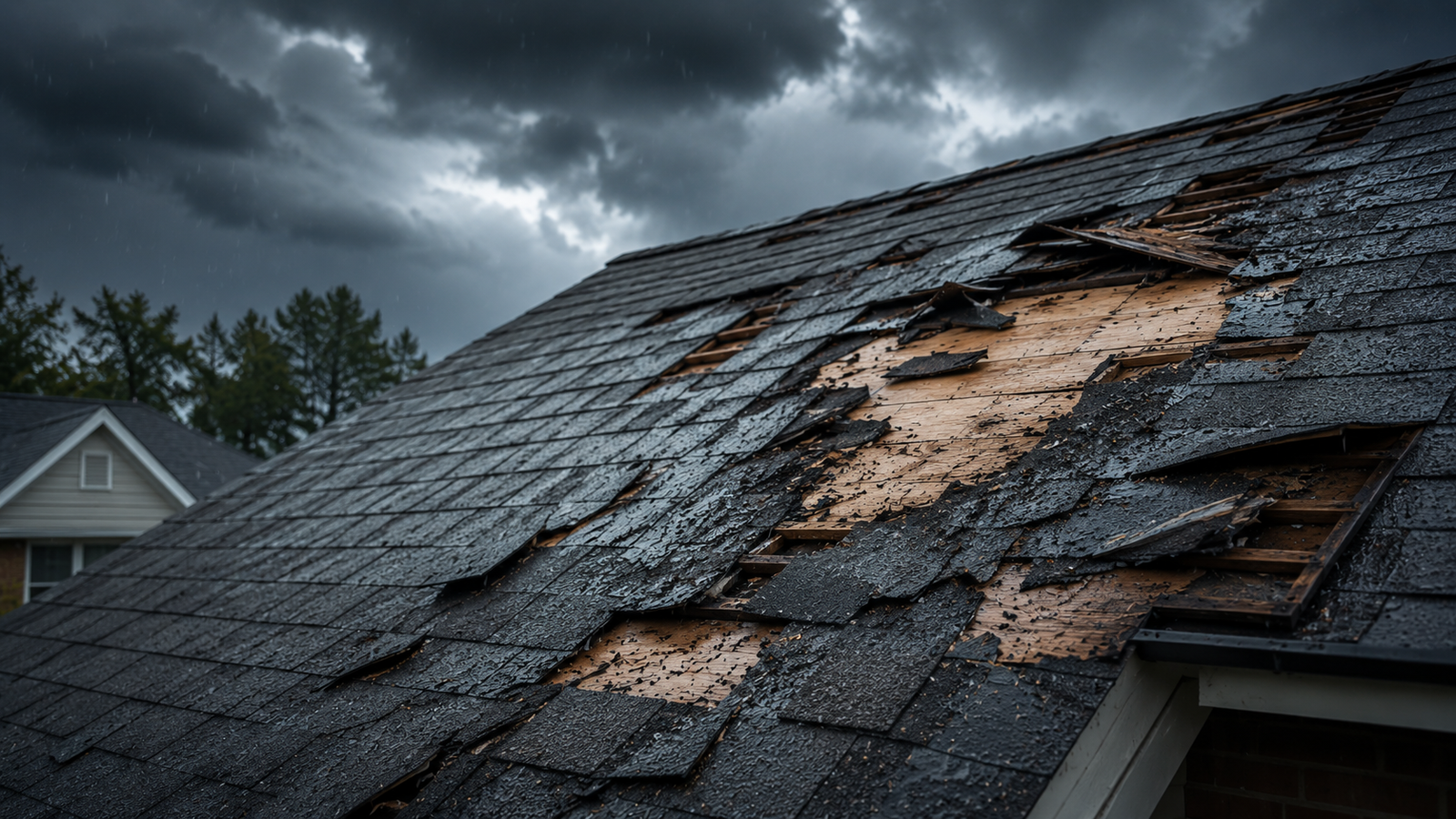
Severe weather brings out-of-town operators to Maryland neighborhoods within days, and their playbook is consistent: unsolicited door-knocking ("we noticed damage from the street"), pressure to sign immediately, large upfront deposits, offers to waive or absorb your insurance deductible, which is insurance fraud with your name on it, no verifiable local address, and no MHIC number they will say out loud. The counters are equally consistent: never sign on the day of the knock, verify the license first, get a second opinion from an established local company, deal with your insurer directly rather than signing over the claim, and photograph the damage yourself. If your roof took storm damage, our guide to spotting and handling roof storm damage covers the whole process, including the insurance side.
Quality Standards and the 3-Phase Inspection Model
Everything above filters out bad contractors. What identifies an excellent one is process, a defined quality standard applied to every roof, not just the ones being watched. At Cliffbrook, we hold our work to Army Corps quality standards, [Add detail on the team's Army Corps of Engineers background/origin of this standard], a construction discipline built on documentation, verification and inspection at defined stages rather than trust and hope. Applied to residential roofing, it takes the form of our 3-phase inspection model:
- Phase 1, pre-installation inspection. Before any work begins: full documentation of the existing roof, decking condition, ventilation, flashing points and problem areas, so the project plan reflects your actual roof, not assumptions, and so decking surprises are planned for rather than improvised.
- Phase 2, mid-installation inspection. After tear-off, with the deck exposed: verification of decking replacement, ice and water shield placement, underlayment, flashing and every water-protection layer, at the only moment in the roof's life these layers can ever be seen. This is the phase most contractors simply do not have, and it is where roofs are truly made or broken.
- Phase 3, final inspection and walkthrough. Fastening patterns, ridge and penetration details, cleanup including magnetic nail sweeps, and a complete walkthrough with the homeowner, with the permit's final inspection closing out the record.
The logic is simple: quality that is only checked at the end can only be judged by what remains visible at the end, which on a roof is almost nothing. Inspecting at all three phases means the invisible ninety percent of your roof was verified while it could still be seen. Ask any contractor you interview to describe their equivalent, the answer, or the silence, is informative.
Put Us Through the Checklist
MHIC license on the estimate, insurance certificates on request, written warranties, zero subcontractors, and a 3-phase inspection on every roof. Get a free inspection and estimate, and verify everything in this article for yourself.
The Family-Owned Difference
There is one more filter worth applying, harder to verify on paper but easy to feel in practice. A family-owned roofing business lives or dies on its local reputation: the owners' names are attached to every roof, the same people who sold the job answer the phone when something needs attention, and the company's future depends on this county's homeowners recommending them to neighbors. That alignment of incentives is worth more than any marketing claim.
Cliffbrook is family-owned and has been since 2021, with 75+ years of combined experience across the team and every roof built by our own crews, the structure behind our zero-subcontractor policy and the reason our warranty is backed by people you can actually reach. You can read who we are on our about page, but the better evidence is in the words of the homeowners we have already worked for.
Reliable Roofing Across Silver Spring, DC NW and Maryland
Homeowners searching for trusted roofers in Silver Spring face a particular version of this problem: an older, established housing stock that attracts every kind of operator, from excellent local craftsmen to the fly-by-night crews this article warns about, and the verification habits above matter all the more. Across the river of the county line, finding a top roofing company for DC NW adds the District's own licensing layer, which we carry alongside our Maryland credentials, roofs in Washington DC's northwest neighborhoods are part of our regular service area.
Wherever you are, reliable roof replacement in MD and DC comes down to the same short list: verified license, documented insurance, written warranties, in-house crews, a real inspection process and a local reputation with years behind it. We built Cliffbrook to check every box, MHIC licensed, insured, CertainTeed Master Shingle Applicator certified, family-owned, zero subcontractors, and 3-phase inspected on every project, and we welcome the homeowner who verifies all of it before calling. That homeowner is exactly who we want to work for.