A roof replacement in Montgomery County is not just a construction project; it is a compliance project. The county wants to know the roof is built to code. Your HOA wants to know it will not clash with the neighborhood. Neither cares about the other's paperwork, and both can stop your project, or haunt it years later, if their box goes unchecked.
None of this should scare you off a needed roof. Handled in the right order, by a contractor who does it every week, the whole compliance side runs quietly in the background. This guide explains both rulebooks so you know exactly what is happening, what to ask for, and where the traps are.
Two Layers of Approval, Two Different Jobs
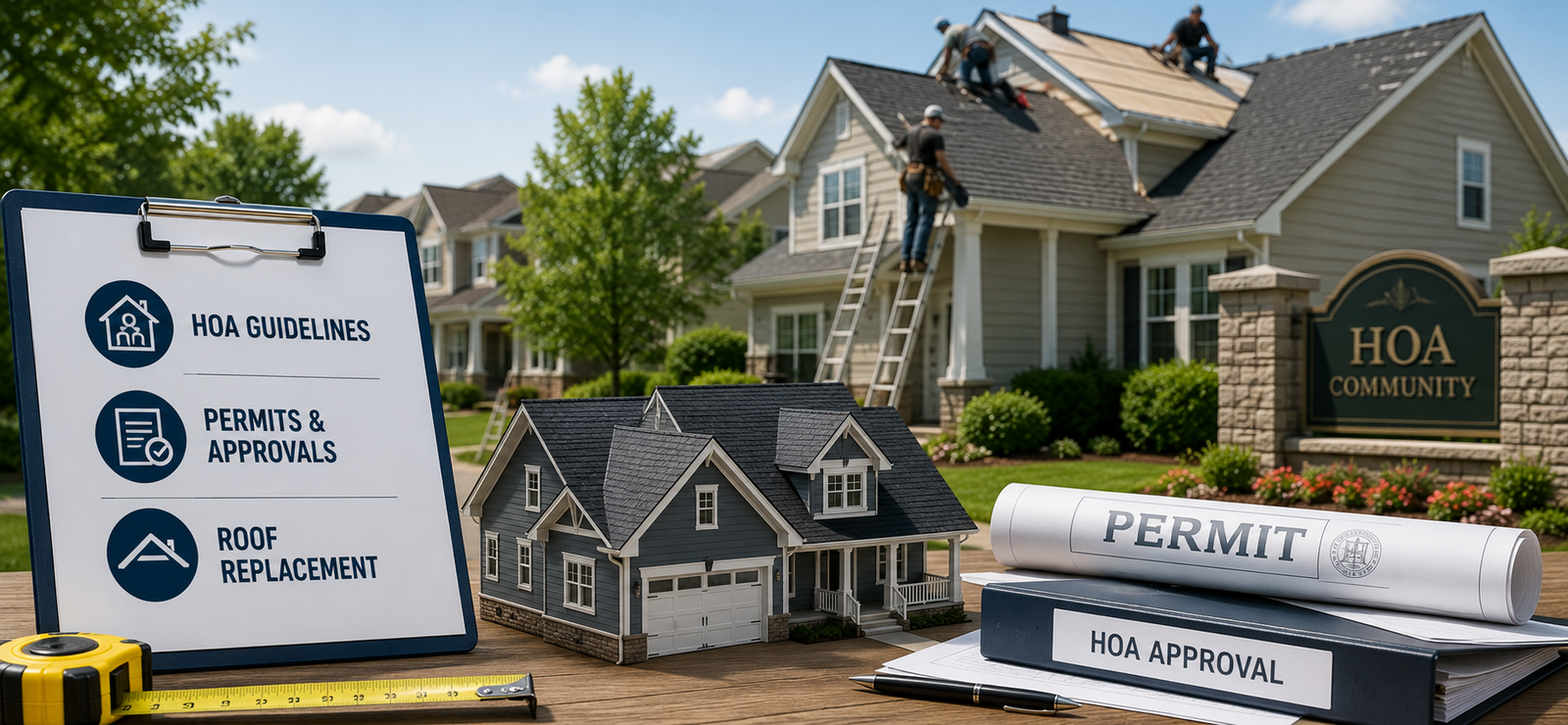
It helps to be clear about who regulates what. The county permit system exists for safety: it verifies through plan review and inspection that your new roof meets the building codes for roof construction, structure, water protection, ventilation and fastening. Your HOA's architectural review exists for appearance and property values: it governs what materials, colors and profiles are acceptable in the community.
They operate independently. HOA approval does not substitute for a permit, and a permit does not exempt you from HOA rules. Full roof compliance means clearing both, and the smart sequence is HOA first (approve the material and color), permit second, build third. Now let us take each layer in turn.
Do You Need a Permit to Replace Your Roof in Maryland?
For most Montgomery County roof replacements, the answer is yes, a residential building permit from the county's Department of Permitting Services (DPS) is part of the job, and the scope of work determines the specifics. Projects that involve replacing roof decking or touching any structural elements are clearly in permit territory, and since decking replacement is discovered on a large share of tear-offs once the old shingles come up, prudent contractors permit the job from the start rather than gambling on perfect decking.
Requirements do evolve, and incorporated municipalities within the county can layer their own rules on top, which is why the practical rule is: confirm current requirements with DPS before work begins, or hire a contractor who does it for you as a matter of routine. We covered the county permit process in detail, costs, timelines, inspections and all, in our dedicated guide, do you need a permit for roof replacement in Montgomery County; this article focuses on how the permit track and the HOA track fit together.
Pulling a Roof Permit: How It Actually Works
Pulling a roof permit is straightforward for a contractor who does it constantly: an application to DPS describing the scope of work, applicable fees, issuance, and then inspections at the required stages with a final sign-off that closes the permit. The homeowner's involvement, when the contractor handles it properly, is essentially zero.
One point deserves emphasis. The contractor should pull the permit, not you. When the contractor is the permit holder, they are on record as responsible for code compliance, and the inspections check their work. When a contractor asks the homeowner to pull the permit instead, responsibility quietly shifts to you, and it is a classic move of operators who cannot pull permits themselves because they lack proper licensing. It is one of the warning signs we detail in our guide to choosing a roofing contractor in Montgomery County.
Any legitimate Maryland contractor's license can be verified through the Maryland Home Improvement Commission (MHIC) license lookup, and permit status in Montgomery County can be checked through DPS. Both checks take minutes and cost nothing. A contractor who is comfortable being verified is a contractor you can work with; one who bristles at the question is answering it for you.
The Building Codes That Shape Your Roof
Permits exist to enforce codes, and it is worth knowing what the code actually buys you, because these requirements are the difference between a roof that survives Maryland weather and one that does not:
- Ice and water protection at the eaves, the self-adhering membrane that defends against ice dam backup in our freeze-thaw winters.
- Underlayment requirements across the deck as the secondary water barrier beneath the shingles.
- Flashing standards at chimneys, walls, valleys and penetrations, where most leaks are born.
- Fastening schedules matched to wind exposure, the nailing pattern that keeps shingles on through summer thunderstorms.
- Ventilation requirements for the attic, which protect both the shingles and your ice dam defenses.
- Decking condition standards, rotted or delaminated decking must be replaced, not covered over.
Notice that every item on that list is invisible from the street the day the roof is finished. That is precisely why inspection matters: it verifies the parts of the roof you will never see, done by someone other than the person who built it. Code compliance is not bureaucracy; it is the cheap insurance built into the process.
What Happens If You Replace a Roof Without a Permit?
Skipping the permit saves a small fee now and creates open-ended liability later. The county can issue stop-work orders and fines and require retroactive permitting, which can mean opening finished work for inspection. At resale, unpermitted work surfacing in the buyer's due diligence can stall the sale, force corrections on a deadline, or cost you a price concession. If the roof ever fails, your insurer discovering unpermitted work gives them grounds to contest the claim. And in an HOA community, unapproved work stacks association fines and mandated correction on top. No honest math makes it worth it, which is why a contractor proposing to skip the permit is disqualifying himself.
How HOAs Regulate Roofing
Now the second rulebook. Homeowners associations regulate roofs through their architectural guidelines, and in Montgomery County's planned communities those guidelines are often detailed and firmly enforced. Typical HOA approved roofing rules cover:
- Approved materials, many associations specify architectural shingles and prohibit or restrict 3-tab; some allow or restrict metal, slate or cedar by section.
- Approved colors, often a defined palette, sometimes down to specific manufacturer color names.
- Consistency requirements, matching the community's established look, or in townhome rows, coordinating with attached neighbors.
- Process requirements, an architectural review application before work begins, with defined documentation.
- Contractor requirements, proof of license and insurance is commonly required with the application.
The rules feel restrictive, but they cut both ways: they also protect your property value from a neighbor's regrettable choices. The key is treating the HOA as a process to run, not a fight to win, and running it early.
Getting HOA Approval for a New Roof Color or Material
Here is the playbook for how to get HOA approval for a new roof, refined across many association-governed projects:
- Get the current guidelines first. Request the architectural standards and application form from the management company before choosing anything. Rules change; old neighbor advice is not documentation.
- Choose from the pre-approved palette when one exists. A pre-approved color and material sails through review; a novel choice invites a committee debate you do not need.
- Submit a complete package. Manufacturer, product line, exact color name, a physical sample or swatch, contractor license and insurance certificates, and photos if requested. Incomplete applications are the number one cause of delay.
- Mind the calendar. Committees usually meet monthly and approvals commonly take 30 to 60 days. Submit well before your target start, and never let storm season be your deadline.
- Get the approval in writing and keep it with your permit records permanently; it is part of the home's paper trail at resale.
A contractor who works HOA communities regularly will assemble this entire package for you, spec sheets, samples, certificates, which converts the most annoying part of the project into a formality. It is a service worth explicitly asking about when comparing bids.
Roof Replacement Without the Paperwork Headache
We handle the whole compliance track: HOA application packages, county permits, inspections and final sign-off, alongside the roof itself. One licensed, insured, MHIC-credentialed crew, zero subcontractors, across Bethesda, Potomac, Rockville and all of Montgomery County.
The Historic District Layer
A third rulebook applies in some neighborhoods: historic preservation review. Homes in designated historic districts, parts of Takoma Park, Chevy Chase, Kensington and other pockets of the county, may need a historic area work permit before exterior changes, with review focused on historically appropriate materials. This is where slate and cedar stop being aesthetic upgrades and become the required answer, and where installer credentials matter most; we covered that world in our guide to specialty roofing for historic homes. If your home is in or near a historic district, confirm its status before planning materials, your contractor should raise this question, not you.
What a Licensed Local Roofer Handles For You
Pull the threads together and the value of the right contractor becomes obvious. A licensed local roofer who works Montgomery County's regulated neighborhoods every week brings exactly the knowledge this process rewards:
- MHIC licensing and insurance that pass both county and HOA requirements, with certificates ready for the application package.
- Permit fluency, pulling the permit as the responsible party, scheduling inspections, closing the permit with final sign-off.
- HOA experience, knowing what architectural committees ask for and preparing submissions that clear review the first time.
- Code-first installation, ice and water shield, flashing, fastening and ventilation done to pass inspection because that is simply how the crew builds.
- A complete paper trail, approvals, permits and inspection records you will be glad to have at resale.
Every item above is standard on our projects. It is also, frankly, a filter: contractors who resist permits, dodge HOA paperwork or ask you to pull your own permit are showing you the corner-cutting you would get on the roof itself, where you cannot see it. Compliance behavior predicts installation behavior.
Bethesda, Potomac and Rockville: Where the Rules Run Strictest
The county's most regulated roofing environments cluster in its most established communities. HOA roofing rules in Bethesda and its planned neighborhoods are among the most detailed anywhere in the region, with tightly defined material and color standards. Potomac's estate communities pair HOA oversight with premium material expectations, slate and cedar territory where architectural review and craftsmanship both run high. And homeowners searching for a licensed roofing contractor in Rockville are often navigating townhome and planned-community associations where coordination with attached neighbors adds its own wrinkle.
Across all of them, and in Gaithersburg, Silver Spring, Olney and every association-governed street in Montgomery County, the winning formula does not change: HOA approval first, county permit second, code-quality installation third, documentation kept forever. We run that playbook on every regulated project, with 75+ years of combined experience, MHIC licensing, CertainTeed Master Shingle Applicator certification and zero subcontractors, so the only thing you notice about compliance is that it never became your problem.