When homeowners budget for a roof, gutters are usually an afterthought, a line item at the bottom of the estimate. That is backwards. A roof sheds water; the gutters decide where that water goes. If the gutter system leaks, overflows or sags, the water ends up soaking the roof edge, rotting the fascia, and seeping toward the foundation, exactly the damage the roof was supposed to prevent. Seamless gutter installation is the single most effective upgrade to that system, and it is why we treat gutters as part of the roof, not an accessory to it.
Our roof and gutter service exists precisely because the two work as one system. In this guide we will walk through what seamless gutters are, why they outperform traditional sectional gutters, what they cost, and how to get the sizing and installation right for a Maryland home.
What Are Seamless Gutters, Exactly?
Seamless gutters are not bought off a shelf. They are fabricated on site, at your house, on installation day. A portable roll-forming machine feeds a coil of flat aluminum through a series of dies and extrudes a finished K-style gutter in one continuous piece, cut to the exact length of each run of your roofline. A 42-foot stretch of roof edge gets a single 42-foot gutter, no joints, no splices.
The only places a seamless system has connections at all are the corners (miters) and the downspout outlets, and those are factory-grade joints, sealed and riveted, not the every-ten-feet snap-together seams of a sectional system. That is the whole idea: fewer joints, fewer failure points, and a gutter that fits your home like it was made for it, because it literally was.
Why Are Seamless Gutters Better Than Regular Gutters?
Traditional sectional gutters come in pre-cut lengths, typically ten feet, that get joined together with connectors and sealant. Every one of those joints is a future problem. Sealant dries out and cracks with our freeze-thaw cycles, joints work loose as the gutter expands and contracts, and each seam creates a tiny ledge inside the gutter where leaves and shingle grit snag and start a clog.
Seamless gutters remove that entire category of failure. The practical differences over a system's life:
- Far fewer leaks. Seams are the number one place gutters leak. A seamless run has none along its length.
- Fewer clogs. A smooth interior with no joint ridges gives debris nowhere to catch, so water and leaves flush through to the downspouts.
- Better structural integrity. One continuous piece resists sagging and separation better than linked sections carrying the same water and ice load.
- Cleaner appearance. No visible joints every ten feet, just an unbroken line along the roof edge, which matters on any home and especially on higher-end properties.
- Lower lifetime maintenance. No seams to reseal every few years, which is a chore sectional gutter owners know well.
The honest trade-off is upfront price: sectional costs less on day one, and it is the DIY option since the pieces are hardware-store items. But the resealing, patching and leak chasing that sectional systems demand tends to erase the saving, and the roof damage a leaking seam can cause dwarfs it. For a system meant to last 20 or more years, seamless is the better value for nearly every Maryland home.
How Seamless Gutters Protect Your Roof
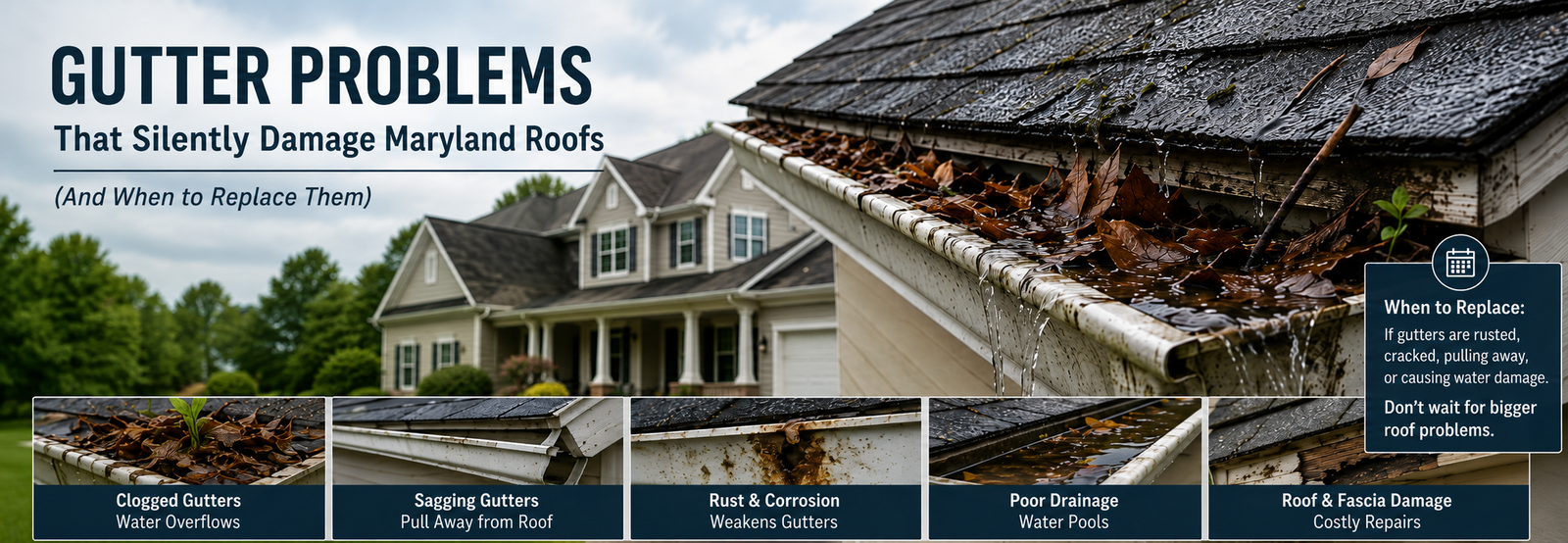
The connection between gutters and roof health is direct. Proper roof drainage means water leaves the roof edge immediately and travels away from the house. When drainage fails, water lingers exactly where the roof is most vulnerable: the eaves, the drip edge, the fascia and the first courses of shingles.
A leaking gutter seam drips water down the fascia board day after day, rotting it slowly. An overflowing, clogged gutter pushes water backwards, under the shingles, into the decking. In winter, gutters holding standing water freeze solid and become the anchor point for ice dams that force meltwater into the attic. We covered these failure modes in detail in our guide to gutter problems that silently damage Maryland roofs, and the pattern in every one of them is the same: the damage starts at a gutter weak point, and seams are the most common weak point of all.
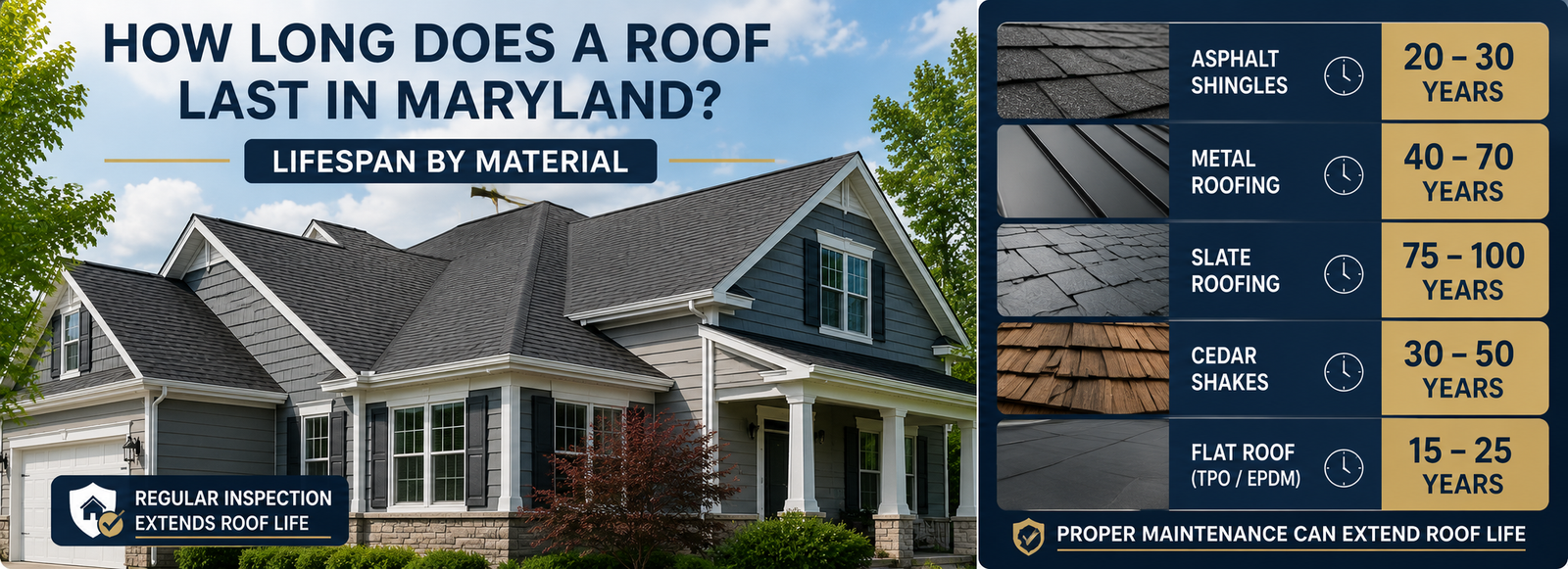
Seamless gutters attack the problem at its source. Fewer seams means fewer leaks onto the fascia, fewer clog points causing overflow, and more consistent flow to the downspouts in heavy rain. That protection compounds over the years, and it is a meaningful part of reaching the full lifespan your shingles are rated for, something we break down in how long a roof lasts in Maryland.
Shingle manufacturers design their warranties around a properly draining roof edge. Chronic water backup from failing gutters causes the kind of edge and decking damage that is expensive to repair and easy to prevent. In our inspections across Montgomery County, a large share of the fascia and roof-edge rot we find traces back to leaking gutter seams, not the roof itself.
Aluminum Seamless Gutters: The Maryland Standard
Aluminum seamless gutters are the default choice for good reason. Aluminum does not rust, stands up well to Maryland's humidity and freeze-thaw winters, is light enough not to strain the fascia, and comes in dozens of baked-on factory colors that hold their finish for decades. Quality installations use .032-gauge aluminum, noticeably sturdier than the thinner .027 stock used in budget jobs, and it matters when gutters carry snow and ice load every winter.
The alternatives each have a niche. Copper is beautiful and can last 60 or more years, which makes it a fit for the high-end and historic properties we serve in areas like Potomac, but it costs several times more. Galvanized steel is strong but will eventually rust and has largely given way to aluminum. Vinyl is the budget material and simply does not survive our winters well. For the overwhelming majority of homes, .032 aluminum seamless gutters hit the right balance of durability, appearance and cost.
Sizing and Downspouts: Where Drainage Is Won or Lost
A seamless gutter still fails if it is undersized. Gutter capacity has to match the roof feeding it, and that comes down to three factors: the square footage of roof draining to each run, the roof's pitch (steeper roofs shed water faster), and how intense local rainfall gets, and Montgomery County's summer thunderstorms can be intense.
Standard 5-inch K-style seamless gutters handle most homes comfortably. 6-inch gutters carry roughly 40 percent more water and earn their place on large or steep roofs, on long roof planes that drain to a single run, and on fast-shedding surfaces like metal or slate. If your current gutters overflow in heavy rain even when clean, that is an undersizing symptom, not a cleaning problem.
Downspouts are the other half of the equation. A good rule is one downspout for every 30 to 40 feet of gutter, sized to the gutter (2x3 inch for 5-inch gutters, 3x4 inch for 6-inch), with extensions that discharge water well clear of the foundation. Plenty of gutter problems we diagnose are actually downspout problems: too few of them, or water dumping right at the basement wall. A proper seamless installation calculates all of this from your actual roof rather than defaulting to whatever was there before.
What Do Seamless Gutters and Downspouts Cost?
The average cost of seamless gutters and downspouts in our area runs roughly 8 to 15 dollars per linear foot installed for standard aluminum, which includes the material, hangers, downspouts, sealed miters and removal of the old gutters. A typical single-family home needs 150 to 200 linear feet, putting most full replacements between 1,500 and 3,000 dollars.
| Option | Typical Installed Cost | Notes |
|---|---|---|
| 5" Aluminum Seamless | $8 – $12 per linear foot | The standard for most Maryland homes |
| 6" Aluminum Seamless | $10 – $15 per linear foot | Large, steep or fast-shedding roofs |
| Copper Seamless | $25 – $40+ per linear foot | Premium and historic properties |
| Gutter Guards (add-on) | $5 – $12 per linear foot | Varies widely by guard type |
| Typical Whole-Home Project | $1,500 – $3,000 | 150–200 LF, aluminum, with downspouts |
What moves the number: home size and stories (second-story work costs more), roofline complexity (every corner is a mitered joint), the number of downspouts, material choice, and add-ons like guards or fascia repair. Treat any quote that is dramatically cheaper with caution; the savings usually come from thin .027 stock, wide hanger spacing, or skipped fascia repairs, the exact shortcuts that shorten a gutter system's life.
If a roof replacement is anywhere on your horizon, price the gutters as part of the same project. Combining the work saves on mobilization and lets the drip edge and gutters be installed as one coordinated system, and it is almost always cheaper than doing the two jobs a year apart.
Want an Exact Price for Your Home?
We measure your roofline, check the fascia, and give you a written, no-pressure quote for seamless gutter installation, and a free look at your roof while we are up there. Serving Olney, Kensington, Silver Spring and all of Montgomery County.
Pairing Seamless Gutters With Gutter Guards
Seamless gutters eliminate seam leaks and joint clogs, but they still catch whatever falls from the trees above them. In the heavily wooded neighborhoods around Olney, Brookeville and Kensington, that means serious leaf loads every fall. Gutter guards are the natural companion: quality guards keep leaves and larger debris out, cutting cleaning frequency dramatically and, more importantly, cutting the clog risk that causes overflow and ice-dam trouble.
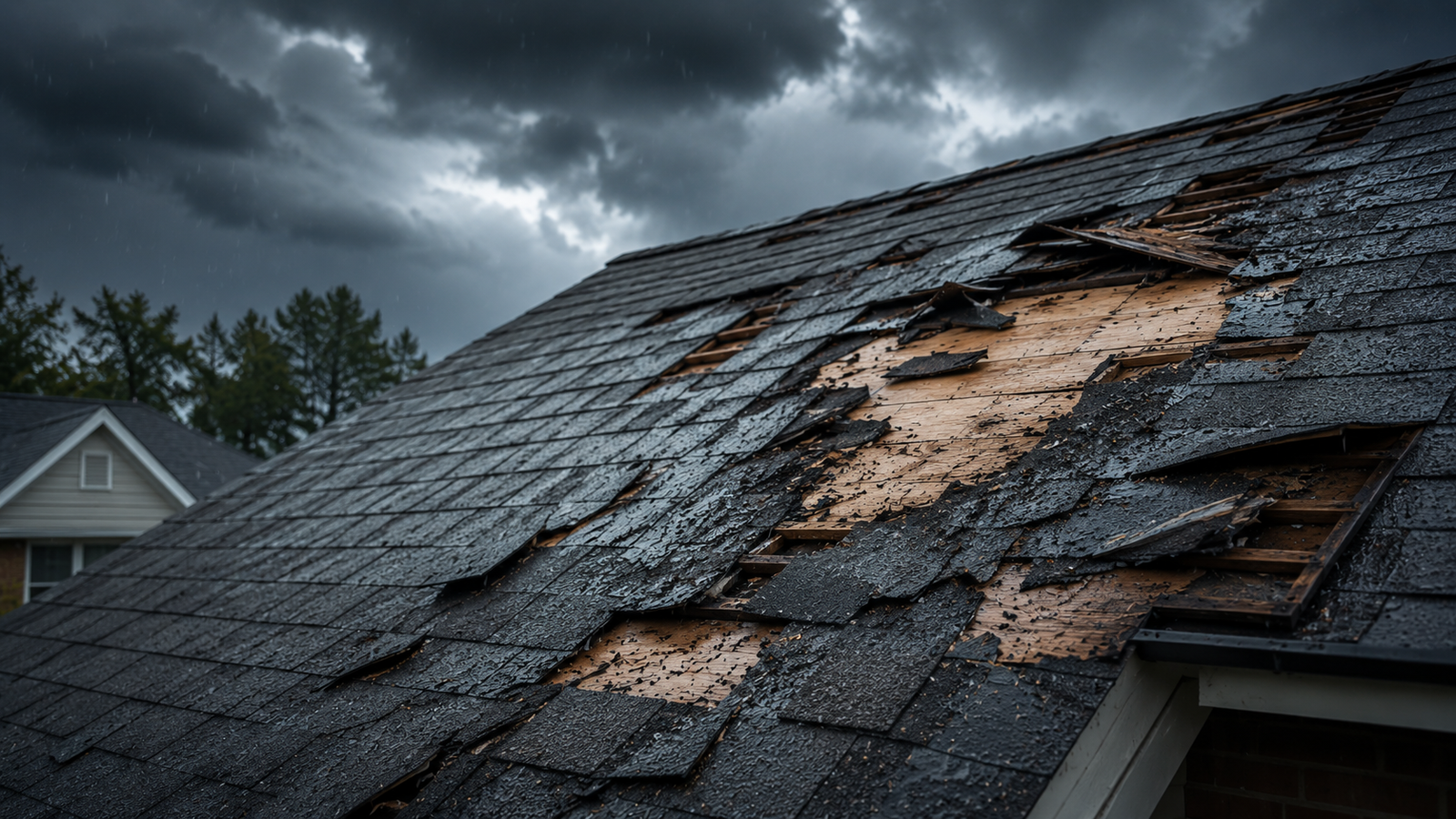
The pairing is genuinely better than the sum of its parts. Guards keep debris out of a gutter that has no internal seams for fine grit to catch on, so what does get through tends to wash to the downspouts on its own. The usual caveats apply, guards are clog-resistant rather than maintenance-free, and quality of both product and installation matters, but installing guards at the same time as new seamless gutters is the most cost-effective moment to add them. If storms have you thinking about the roof above the gutters too, our guide to spotting hidden storm damage covers what to look for.
Roof and Gutter Replacement: Better Together
A large share of our seamless gutter installations happen alongside a roof replacement, and for good reason. A roof and gutter replacement done as one project means the drip edge, underlayment and gutters are installed in the correct sequence by the same crew, so flashing and drainage work as a single engineered system rather than two trades' work meeting awkwardly at the roof edge. It is also simply cheaper than mobilizing twice.
The decision logic is straightforward. If your gutters are 15-plus years old, leaking at seams, sagging, or undersized for the roof, replace them with the roof. If they are recent seamless gutters in good condition, they can usually be protected during the roof work and kept. If you are still weighing whether the roof itself needs replacing at all, our roof repair vs replacement guide walks through that call, and because we handle both roofing and gutters in-house with zero subcontractors, you get one honest assessment of both systems instead of two contractors each selling their own piece.
What Professional Seamless Installation Looks Like
Because seamless gutters are fabricated on site, installation quality is everything, the machine makes a perfect gutter, but people hang it. A proper installation includes:
- Fascia inspection and repair first. New gutters screwed into rotted fascia will sag within a couple of seasons. Any soft or damaged boards get replaced before the gutters go up.
- Correct pitch. Gutters must slope subtly toward the downspouts, roughly a quarter inch per ten feet. Too flat and water stands; too steep and it looks wrong and overruns the downspout in heavy rain.
- Hidden hangers, properly spaced. Screwed hidden hangers every 24 inches or less (closer in ice-prone spots), not the old spike-and-ferrule method that works loose.
- Sealed, riveted miters at corners, the only joints in the system, done to last.
- Downspout placement calculated from roof area, with extensions carrying water well away from the foundation.
- Integration with the drip edge so water off the shingles lands in the gutter, not behind it, the small detail that prevents years of hidden fascia rot.
These are the checkpoints worth asking any contractor about, and they are the same details we verify when gutters come up during a roof inspection. If you want to know what a thorough inspection covers top to bottom, our roof inspection guide lays it out.
Seamless Gutters in Olney, Kensington, Silver Spring and Beyond
The case for seamless gutters is strongest exactly where we work. The mature tree cover in Olney, Brookeville and Laytonsville means heavy leaf loads that punish seamed, clog-prone gutters every fall. The established homes of Kensington and Silver Spring frequently still carry decades-old sectional systems that are past due for gutter replacement, often with fascia repairs needed behind them. And across Gaithersburg, Germantown and the rest of Montgomery County, the same summer downpours and freeze-thaw winters test every gutter system the same way.
As roof and gutter contractors serving all of these communities, we fabricate seamless gutters on site, handle the fascia work, guards and downspouts, and back it with the same crew and standards as our roofing work, 75+ years of combined experience, MHIC licensed, and never a subcontractor. Whether it is a straightforward gutter replacement in Kensington or a full roof-and-gutter project in Olney, the assessment starts the same way: a free inspection and an honest recommendation.
Gutters are the least expensive part of the roof system and the one that quietly determines how long the rest of it lasts. Getting them right, seamless, correctly sized, properly hung, is some of the best money a homeowner can spend on protecting the house.